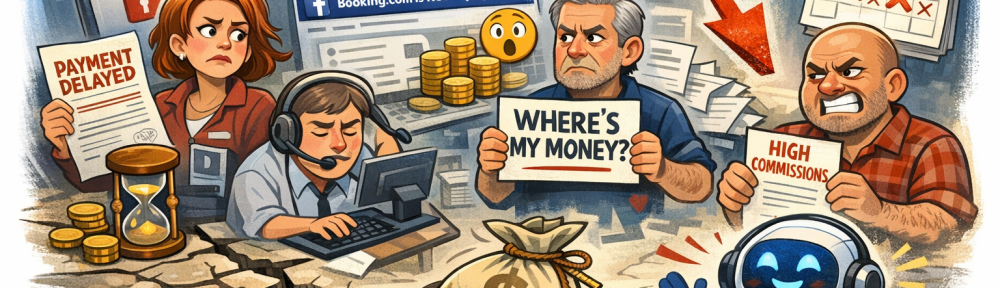
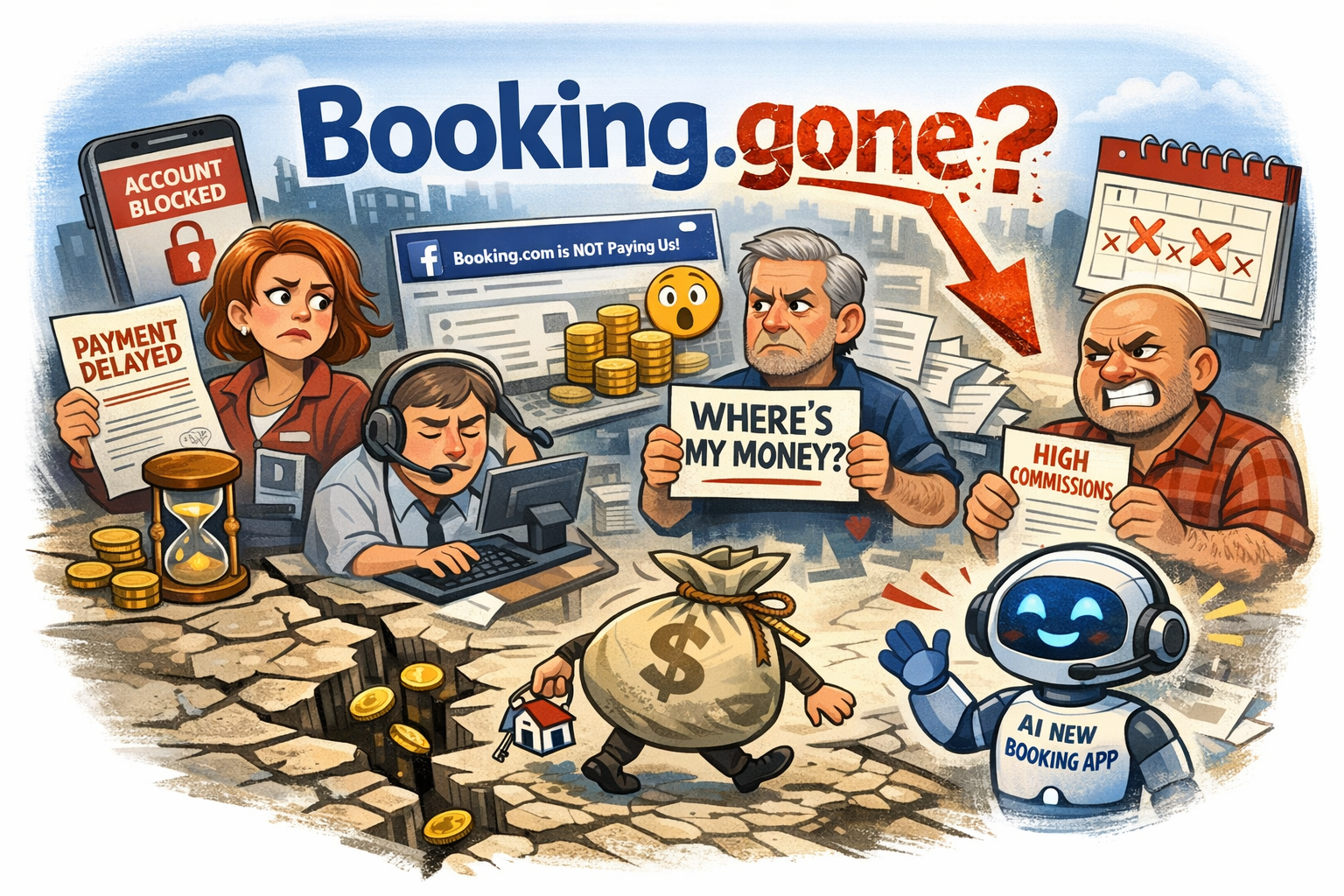
Booking.com still looks like a colossus from the outside: huge inventory, huge brand recognition, huge market power. But among the people who actually supply the product — property owners and managers — the mood in parts of the ecosystem is closer to “please stop breaking my business with your software and bad service” than “valued partner”.
A quick trawl through owner/partner feedback doesn’t read like a love letter. On Trustpilot, the admin.booking.com (partner/extranet) side carries a very low TrustScore (around 1.1/5) based on hundreds of reviews, with recurring themes: payment friction, account blocks, support dead-ends, and systems that feel designed to protect processes rather than people.
The core complaint: software-first, partner-last
The pattern is strikingly consistent: hosts don’t just complain about one bad incident — they complain about how hard it is to fix anything once the machine has decided you’re wrong.
Common “owner-side” grievances you see repeatedly:
- Payments delayed, withheld, or offset in ways partners say are hard to reconcile.
- Properties “closed” automatically for invoice disputes or timing issues, with reinstatement rules that feel blunt-force. Booking.com’s own partner guidance describes reopening only after paying outstanding balances when auto-closure triggers.
- Support routed through inboxes and apps that can feel like a maze when the issue is financial and time-sensitive (i.e., rent money).
- Calendar / sync complexity (and the ever-present spectre of overbookings) pushed onto partners to solve via integrations and procedures.
None of this is fatal if partners feel protected and heard. The problem is that many don’t.
Real-world “cock-ups” owners describe (in their own words)
Here are a few representative examples from public partner/host feedback channels — not as courtroom findings, but as a snapshot of sentiment and the kinds of operational pain being reported:
- “Commission first, host second”
A Trustpilot reviewer on the partner/admin side frames it bluntly: Booking.com “as long as they get their commission, the host is unimportant,” then describes guest-side issues and slow host response posting. - Account blocks and invoice/payment spirals
Multiple Trustpilot partner reviews reference finance/invoice disputes leading to properties being blocked or closed, with partners pushed into “prove you paid” loops. - “Pulse” app frustration (hosts say errors cost them money)
On Apple’s App Store listing for Pulse for Booking.com partners, reviewers complain the app creates errors that hosts end up paying for, plus difficulty reaching competent support. - A whole community built around “not getting paid”
There is a large Facebook group titled “booking.com is not paying its hosts” (thousands of members). Separately, DutchNews.nl reported in October 2023 that thousands of hosts joined a special Facebook group to share experiences about delayed payments.
Even allowing for the usual social-media amplification, the very existence and scale of this kind of group is… not ideal brand architecture.
Commissions: when “marketplace rent” starts to look abusive
Here’s the uncomfortable bit: regulators are sniffing around the business model, and not just on the consumer side.
In Switzerland, the price watchdog ordered Booking.com to reduce commissions for Swiss hotels, calling the rates “abusively high” and requiring a cut of nearly 25% (Booking.com said it would appeal).
Meanwhile, European pressure over platform practices (including parity clauses and competition issues) has also been building in other jurisdictions.
That matters because the platform’s margin story depends on commissions staying chunky while partners keep absorbing operational hassle.
Why this creates an opening for AI-native competitors
Booking.com’s biggest vulnerability isn’t “a bad quarter.” It’s the trust gap between platform and supplier.
An AI-native booking challenger doesn’t need to beat Booking.com at everything on day one. It only needs to win the owner experience:
- Instant, transparent payout reconciliation (ledger-style, explainable offsets, real-time STR/withholding visibility)
- Human-grade support triage (AI that actually resolves, not just routes)
- Dispute handling with audit trails (evidence uploads, decision logs, timelines)
- Smart calendar risk prevention (AI detecting overbooking risk before it happens, not after)
If the platform that owns demand keeps treating supply like an interchangeable commodity, supply will eventually diversify distribution — direct bookings, niche platforms, cooperatives, and newer tools that don’t treat a missing payment like a fun puzzle.
Booking.com won the last era by being the biggest door in town. It could lose the next one by becoming the most exhausting door to use.
And partners, unlike guests, don’t just leave a bad review.
They leave with their keys.
 Jason I J Smith