
Alex McIntyre, Gloucester’s MP, has now received detailed written answers from Gloucester City Council in response to his questions about the authority’s serious financial problems. On the surface, the responses sound reassuring. Look a little closer, and a different picture emerges.
The Council admits serious failures — but avoids responsibility
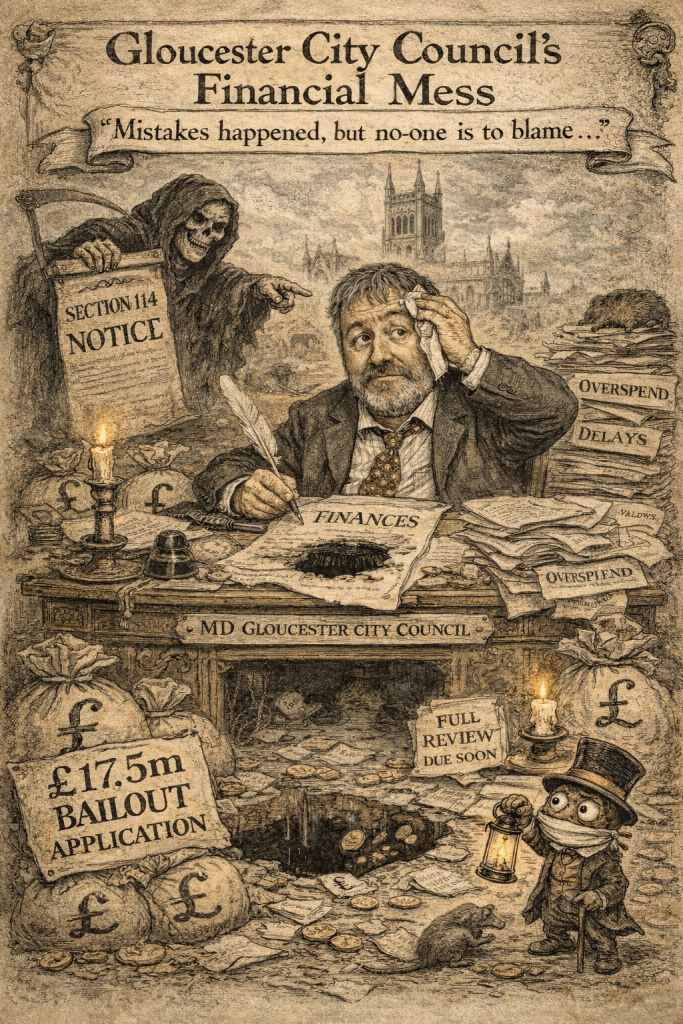
The Council accepts that there have been major overspends, forecasting errors, and delayed responses over several years. However, nowhere in the responses is a single decision-maker named, nor is any individual held accountable. Problems are consistently described as “systemic”, “complex”, or the result of “uncertainty”.
In short: mistakes happened, but no one appears to have made them.
The cyber-attack explanation has worn thin
A cyber-attack in 2021 is repeatedly cited as the reason for weak financial control — including the striking admission that effective budget monitoring did not properly operate for several years, only being fully reinstated in December 2025.
Four years on, this explanation no longer stands up. At some point, recovery delays become management failures.
Big projects, big optimism, little realism
The Council maintains that the original revenue forecasts for the Forum development remain “accurate”, despite:
major construction delays,
delays in completing leases,
weaker income than expected,
and revised forecasts now acknowledging shortfalls.
These positions are difficult to reconcile. Either the forecasts were right, or the outcomes are telling us they were not.
Overspends are explained — not justified
The Council provides itemised explanations for overspends on IT, asset compliance, cemeteries, emergency works and security incidents. What is missing is any clear assessment of whether:
the spending was reasonable,
earlier intervention could have reduced costs,
or stronger controls should have been in place.
Transparency is offered, but value for money is not demonstrated.
Accountability is always deferred
Independent investigations, full reviews, and comprehensive reports are repeatedly promised — mostly in the future. Key questions raised by the MP about who knew what, when problems were identified, and why corrective action was delayed remain unanswered.
The bottom line
This is not just a story about money. It is a story about governance and accountability.
The Council is asking residents to trust a financial recovery plan while simultaneously admitting:
years of weak financial control,
delayed monitoring and reporting,
and an absence of individual accountability.
Public trust cannot be rebuilt through reassurance alone. It requires clarity, ownership of mistakes, and visible consequences — all of which remain conspicuously absent.
 Jason I J Smith