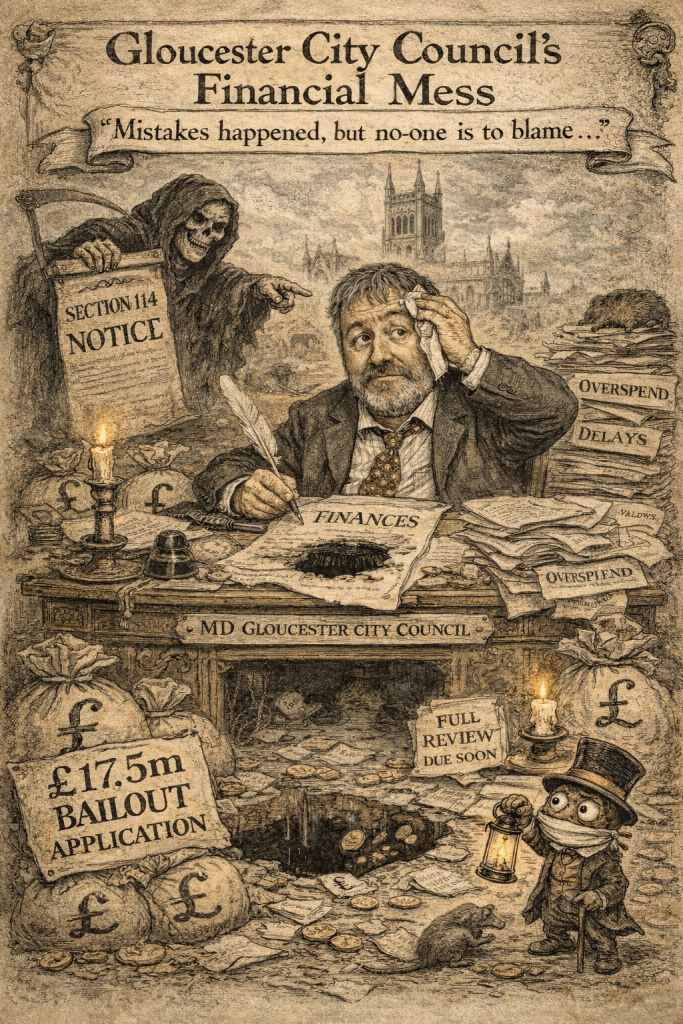
Alex McIntyre, Gloucester’s MP, has now received detailed written answers from Gloucester City Council in response to his questions about the authority’s serious financial problems. On the surface, the responses sound reassuring. Look a little closer, and a different picture emerges.
The Council admits serious failures — but avoids responsibility
The Council accepts that there have been major overspends, forecasting errors, and delayed responses over several years. However, nowhere in the responses is a single decision-maker named, nor is any individual held accountable. Problems are consistently described as “systemic”, “complex”, or the result of “uncertainty”.
In short: mistakes happened, but no one appears to have made them. The cyber-attack explanation has worn thin A cyber-attack in 2021 is repeatedly cited as the reason for weak financial control — including the striking admission that effective budget monitoring did not properly operate for several years, only being fully reinstated in December 2025.
Four years on, this explanation no longer stands up. At some point, recovery delays become management failures. Big projects, big optimism, little realism The Council maintains that the original revenue forecasts for the Forum development remain “accurate”, despite:
major construction delays, delays in completing leases, weaker income than expected, and revised forecasts now acknowledging shortfalls.
These positions are difficult to reconcile. Either the forecasts were right, or the outcomes are telling us they were not.
Overspends are explained — not justified The Council provides itemised explanations for overspends on IT, asset compliance, cemeteries, emergency works and security incidents. What is missing is any clear assessment of whether: the spending was reasonable, earlier intervention could have reduced costs, or stronger controls should have been in place. Transparency is offered, but value for money is not demonstrated.
Accountability is always deferred Independent investigations, full reviews, and comprehensive reports are repeatedly promised — mostly in the future. Key questions raised by the MP about who knew what, when problems were identified, and why corrective action was delayed remain unanswered.
The bottom line
This is not just a story about money. It is a story about governance and accountability. The Council is asking residents to trust a financial recovery plan while simultaneously admitting: years of weak financial control, delayed monitoring and reporting, and an absence of individual accountability. Public trust cannot be rebuilt through reassurance alone. It requires clarity, ownership of mistakes, and visible consequences — all of which remain conspicuously absent.
For more than a year, Gloucester City Council has been grappling with a growing list of current and historical problems — from disputed financial assumptions and budget gaps, to questions about governance, record-keeping, and how warnings were handled when risks first emerged. Against that backdrop, trust in the council’s internal checks and balances has been steadily eroded, both publicly and within professional local-government circles.
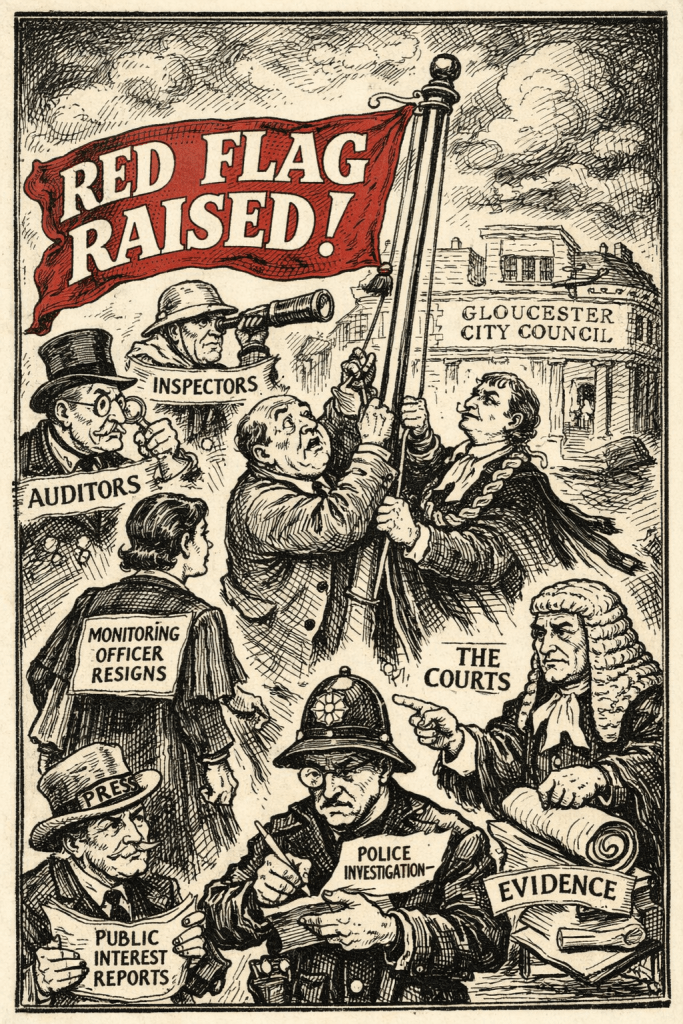
It is in this context that the resignation of the council’s Monitoring Officer takes on real significance.
When a Monitoring Officer leaves after a year, professionals across local government read it as a red flag, not a footnote.
It suggests deep governance stress, unresolved legal risk, and a failure to heed independent legal advice. And it tends not to be the end of departures — merely the first that matters. At Gloucester City Council, this is not a routine staffing change. The Monitoring Officer is a statutory officer — the council’s legal conscience — appointed under the Local Government and Housing Act 1989 to ensure that decisions are lawful, constitutional processes are followed, and standards of conduct are upheld. Where illegality or serious maladministration is suspected, the Monitoring Officer has a legal duty to intervene, including issuing a formal report that compels the authority to stop and publicly address the issue.
Solicitors do not leave such roles lightly, particularly not after only a year in post. In practice, early resignations usually point to one or more of three factors: inherited governance failures that prove impossible to resolve internally; sustained resistance to legal challenge from senior officers or political leadership; or an unacceptable level of personal professional risk. That risk is not theoretical. Monitoring Officers carry individual responsibility. If advice is repeatedly ignored, overridden, or marginalised; especially where governance failures continue or records are questioned the exposure sits with the named officer, not with the abstract notion of “the council”. At that point, remaining in post can jeopardise professional standing and regulatory compliance. Leaving becomes an act of professional self-preservation.
There is also a misconception that resignation draws a line under scrutiny. It does not. A former Monitoring Officer can still be called upon in external audits, public interest reports, regulatory reviews, or court proceedings. In some respects, they may be more able to speak freely once removed from internal pressures.
For governance professionals, this is why such departures matter. They are signals — not of a problem resolved, but of one that has reached a critical point. History suggests they are rarely isolated events.
The question Gloucester now faces is not simply why a Monitoring Officer has gone, but what conditions made it untenable for the council’s statutory guardian of legality to remain. That question will not disappear with her departure.
On Monday 5 January 2026 at 6:30 pm, Gloucester City Council’s Overview and Scrutiny Committee meets under a cloud it did not create, but must now confront.
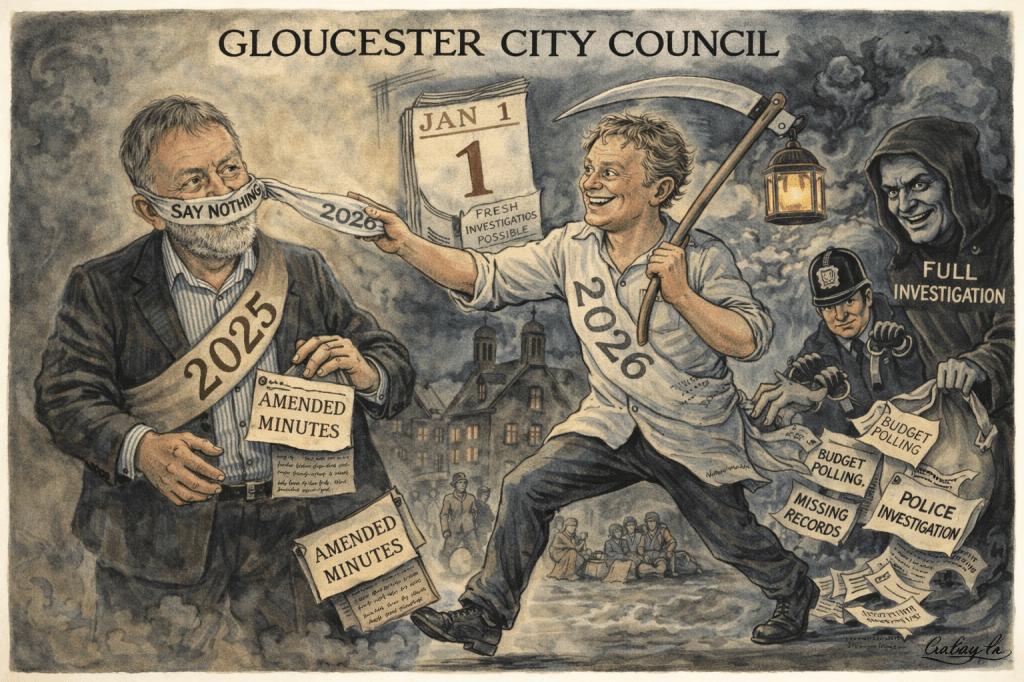
A £17.5 million hole in the Council’s finances has emerged not as a sudden shock, but as the end result of decisions, warnings, and controls that either failed or were ignored. How and when senior officers became aware of the looming deficit, why it was not escalated sooner, and how official records potentially came to be amended and obscured rather than clarified are no longer technical questions, they are matters of public trust.
The questions that follow are not political point-scoring, nor are they unreasonable. They are the minimum that any responsible scrutiny body should be asking if it is to demonstrate independence, restore confidence, and show that those who may be examined are not also deciding which questions are allowed to be asked.
Proposed Questions for Overview & Scrutiny – Gloucester City Council
1. Timing, Knowledge, and Disclosure of the Deficit On what exact date was it first identified by senior officers that Gloucester City Council was likely to face a serious and material budget deficit? At what point did this risk move from being a forecast concern to a known and unavoidable financial shortfall? Once that threshold was crossed, who was informed, when, and by what formal mechanism (Cabinet briefing, written report, risk register update, or otherwise)? Can the Committee confirm whether all councillors were informed at the same time, and if not, why not?
2. KPI Monitoring, Budgetary Controls, and Early Warning Systems What Key Performance Indicators (KPIs) were used to measure financial performance against approved budgets during the period in question? Were these KPIs reviewed monthly, quarterly, or at another interval, and where is the documentary evidence of those reviews? If KPIs were being monitored appropriately, how did a £17.5 million deficit develop without triggering earlier intervention or escalation? If KPIs were not being monitored with sufficient frequency or rigour, does the Council accept that this represents a systemic failure of financial governance?
3. Accuracy, Integrity, and Amendment of Minutes Can the Committee confirm whether meeting minutes were amended after the event in ways that materially altered the record of concerns raised, warnings given, or decisions taken? What governance safeguards exist to prevent retrospective alteration of the official record, and were those safeguards followed in this case? Were any amendments made without explicit committee approval, and if so, who authorised them?
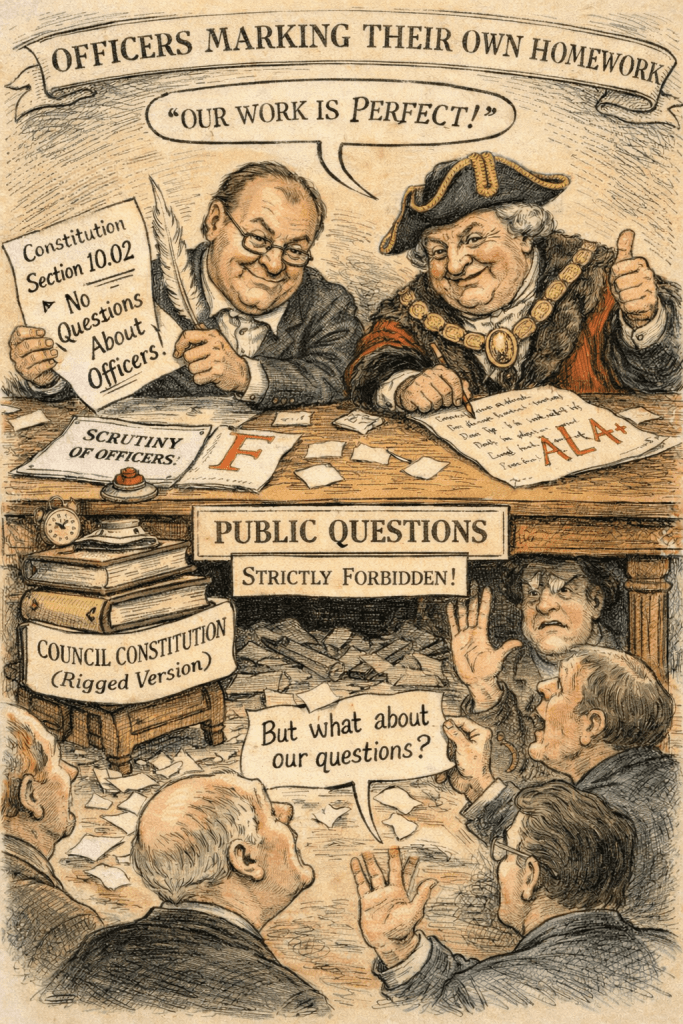
4. Financial Propriety and Officer Accountability Given the seriousness of the deficit and the questions surrounding disclosure and record-keeping, does the Committee accept that there are credible concerns relating to financial propriety and candour at senior officer level? In light of those concerns, how does the Committee justify allowing senior officers who may be subject to scrutiny or investigation to act as gatekeepers of public and member questions?
5. Conflict of Interest and Gatekeeping of Scrutiny Does the Committee accept that it is constitutionally improper and procedurally unsafe for individuals who may be investigated to: determine which questions are admissible, edit or reframe those questions, or exclude lines of inquiry relating to their own actions? What independent safeguards exist to prevent conflicts of interest in the handling of scrutiny questions—and why were they not used here?
6. Free Speech, Democratic Scrutiny, and Procedural Legitimacy Does the Committee believe that current Gloucester City Council procedures unduly restrict democratic scrutiny, particularly where questions relate to officer conduct, governance failures, or statutory duties? How does the Council reconcile its approach with the principles of openness, accountability, and freedom of political expression expected of a local authority? Will the Committee commit to reviewing the legitimacy of procedures that effectively censor questioning under the guise of admissibility, brevity, or officer discretion?
7. Independent Review Finally, given the scale of the financial failure and the procedural concerns raised, does the Committee support: an independent governance review, and/or the involvement of an external auditor or investigator to restore public confidence?
In any functioning democracy, public scrutiny is not a nuisance to be managed—it is the point. Yet in Gloucester, recent events suggest that accountability is being treated less like a civic duty and more like a procedural inconvenience.
Following the revelation of a £17.5 million financial black hole, Gloucester City Council convened an emergency “public meeting” on 18 December. On paper, this appeared to be a moment of openness: residents invited to ask questions; democracy seen to be done. In practice, it was anything but.
Questions relating to the actions of senior officers were explicitly ruled out. Legal threats were aired—towards members of the public and councillors alike. The effect was unmistakable: a warning shot across the bows of anyone tempted to probe too closely.
A Constitution That Controls the Conversation
Under Gloucester City Council’s constitution, the Head of Paid Service, acting in consultation with the Mayor, has the power to:
Reject public questions outright Edit questions for “form and brevity” Reorder, group, or reframe questions Decide what is—and is not—admissible
This goes far beyond basic moderation. In many comparable local authorities, admissibility tests are tightly drawn, procedural in nature, and overseen by independent statutory officers such as the Monitoring Officer. Crucially, questions about official actions, governance decisions, and the exercise of statutory powers are explicitly permitted.
Gloucester’s model is different—and troublingly so.
The Conflict at the Core
The constitution allows questions to be excluded if they concern the “personal affairs or conduct” of officers or members. That wording might sound reasonable—until you look closer. In practice, it risks conflating private life with professional conduct, and shielding senior decision-makers from legitimate scrutiny over how they have exercised public power. When questions about governance, financial oversight, or statutory responsibility can be ruled “inadmissible” by the very officer whose conduct may be in question, the problem is obvious. This is not merely poor optics. It is a structural conflict of interest.
The same individual who may be the subject of public concern helps decide whether questions are heard at all, can soften or reframe questions before they reach the chamber faces no independent appeal or review of those decisions.
Where senior officers also hold multiple statutory roles, power becomes dangerously concentrated—and scrutiny correspondingly diluted.
Why This Matters
Free speech in local democracy does not mean shouting abuse from the public gallery. It means the right to ask difficult, well-founded questions about how public money is managed and how authority is exercised.
A system that filters those questions through the very people being questioned does not protect good governance—it undermines it. It replaces accountability with choreography. It turns public meetings into managed performances, not forums for truth.
At a moment when trust in public institutions is fragile, Gloucester’s constitutional arrangements send exactly the wrong message: that scrutiny is something to be controlled, not answered. If democracy is to mean anything at all, referees cannot also be players—and those entrusted with power cannot be allowed to decide whether they may be questioned about how they used it.
For years, every government has told us that crime is falling — and technically, they’re right. The long-term trend from the mid-1990s shows a sharp drop in violent crime, burglary and car theft. The once-dreaded high-crime Britain of the early Blair era is, statistically, a safer place.
And yet, millions of people walk through Britain’s town centres and feel something else entirely: a creeping sense that the place has gone to pot. They see shuttered shops, tent encampments outside empty Debenhams, security guards patrolling the toiletries aisle, and groups of people clearly struggling with addiction or homelessness. The official line says things have improved. Reality — or at least what feels like reality — often says otherwise.
This divide between crime rates and the experience of disorder is now at the centre of a political storm. Ministers call it “perception.” Critics call it “gaslighting.” But a closer look at the data suggests something more nuanced: people aren’t imagining it. Certain forms of disorder really have worsened — significantly. Just not always the ones politicians want to talk about.
Homelessness: the return of what we thought we’d solved
Rough sleeping fell sharply in the late 1990s and early 2000s. But since 2010, it has surged again. Academic and parliamentary briefings show rough sleeping in England has risen by over 160% compared with 2010, only just below its recent peak. The tents, makeshift bedding and visible destitution that now line many urban centres are not nostalgia or “feelings” — they are a documented reversal of earlier progress.
For a public that lived through the more orderly town centres of the 2000s, the contrast is stark. No wonder people feel their high streets are fraying.
Begging and street disorder: political football, practical problem
Begging itself is difficult to measure, but rough sleeping and begging correlate tightly. The historic clampdowns of the 1990s (backed by the old Vagrancy Act) removed much of it from view. Today’s more humane — and more stretched — approach often means far greater visibility of extreme poverty on the streets.
Politicians routinely turn begging into a moral debate. But for ordinary people walking through town, it registers simply as evidence of decline.
Shoplifting: the numbers the government cannot spin
If there’s one area where the public’s instincts are undeniably correct, it’s retail crime.
Police-recorded shoplifting has soared to two-decade highs, rising from around 340,000 offences in 2023 to well over 500,000 by early 2025. Retailers say the real figure is closer to 20 million thefts a year, with a surge in violence and abuse against staff.
This isn’t “media hype.” This is what drives the locked cabinets, the body-worn cameras, the behind-plastic-cheese aisles that make British shops feel like airport duty-free in a collapsing republic.
Ordinary people see this — and understandably conclude that something is seriously wrong.
Antisocial behaviour: the perception gap that isn’t entirely imaginary
ASB is notoriously subjective. Teenagers hanging around were considered normal in 1998; by 2008 they were rebranded “antisocial”; by 2025 they are a political storyline. But while overall ASB is difficult to trend cleanly, the label itself has grown so powerful that nuisance behaviour now feels like part of a wider breakdown.
Academic studies consistently show a gap between actual crime and fear of disorder — but they also show that visible signs of decay (graffiti, litter, street drinking, rough sleeping) strongly drive fear of crime. Britain now has more of those visible signs than at many points during the 2000s.
So is Britain safer or more disorderly? Uncomfortably, it’s both
The long-term crime drop is real. But so is the rise in the forms of disorder that ordinary people actually encounter on the high street.
For most people, the issue isn’t whether homicide is down 40% or whether burglary is half the 1995 rate. What they see is:
More homelessness
More street addiction
More visible mental health crises
More retail theft and security theatre
More shuttered units and depleted town centres
It’s no surprise they conclude that “the country is going to the dogs.” And, in the specific context of British town centres, they have a point.
The political mistake: blaming the wrong things
This is where the political rhetoric falters. Instead of addressing structural causes — housing scarcity, addiction services, mental health funding, local authority collapse, retail decline, and organised shoplifting — it is easier for politicians to shout about:
“Woke councils”
“Soft policing”
“Migrant beggars”
“Youth disorder”
Those make good headlines, but they don’t solve the underlying problems. We’ve already seen what works:
Housing First programmes cut rough sleeping dramatically in the 1990s and again temporarily during COVID.
Neighbourhood policing reduces fear of crime and improves order, but requires investment.
Addiction and mental health services reduce the cycle of visible disorder that dominates town centres.
Retail crime partnerships (police + shops + councils) have shown measurable effects where properly funded.
None of these are new ideas. They’re just the ones that work.
If Britain wants safer, cleaner town centres, it has to stop performing politics and start solving problems
The irony is that the public’s perception is dismissed as “panic,” yet it tracks closely with the areas where the data genuinely show deterioration. People can sense when a place is fraying long before ministers admit it.
The challenge now is political courage: to acknowledge that the high street disorder people see is real, but the causes are deeper than the headlines suggest.
Blaming the wrong targets is easy. Fixing the right problems is hard — but it’s been done before, and it can be done again.
Gloucestershire is edging toward a “Mass Rapid Transit” (MRT) bus corridor between Cheltenham and Gloucester. It is… something. But for two urban areas that should act as a genuine counterweight to Bristol and Birmingham, an express bus is not the transformative step our county needs. The corridor deserves an integrated, rail-anchored, transit-oriented plan that unlocks housing at scale, stitches the centres together, and builds a platform for future industries rather than simply speeding today’s commute. The prize is more jobs, higher productivity and a step-change in place quality. The risk of doing the minimum is more of the same.
On 29 October, county leaders proposed just £1.25 million to progress MRT design work — modest money for a modest concept.
A vision that matches the geography
Cheltenham and Gloucester already function as a single labour market divided by the M5 and decades of piecemeal transport thinking. Official strategies admit rail connectivity is central to prosperity, yet we continue to default to buses on congested roads.
A credible alternative is on the table:
Re-activate the former rail alignment and run tram-train services centre-to-centre, interworking with the national network. This is not science fiction; the UK has already proved the tram-train model technically and operationally (Sheffield–Rotherham), along with the institutional lessons about standards, power, and signalling.
Add a station at Staverton (Gloucestershire Airport) and repurpose most of the airfield into a 20,000-home transit-oriented district, keeping a compact apron as a VTOL hub feeding BHX, BRS and LHR as advanced air mobility scales up. The county is already exploring new futures for the airport; the question is whether we aim high enough.
This is how you build a real counterweight: by hard-wiring people, jobs, education and culture together with rail, and by placing a major new community on that spine rather than scattering estates around rural junctions.
What the evidence says about rail-anchored growth
We don’t need to guess at the economic upside of modern light rail and tram-train. Multiple UK evaluations point the same way:
Light rail stimulates city economies and investment. The Knowles & Ferbrache synthesis for UKTram found consistent links to business location, private development, labour-market access and image effects across UK systems.
Manchester Metrolink has repeatedly been associated with improved access to jobs, education and healthcare and with development around stops; the “transformative impacts” literature used Metrolink as a UK case.
Nottingham NET Phase Two supported around 1,600 direct construction jobs at peak, with documented local skills and supply-chain programmes, an approach local authorities are urged to copy because it converts construction spend into local employment and capability.
Rail investment uplifts land value and drives new homes. Crossrail’s pre-opening studies estimated £20.1 bn of additional residential value and up to 180,000 homes in the pipeline; a separate assessment found a ~2.2% house-price uplift near stations over 2008–2019. While our scheme is smaller, the direction of travel is clear: high-quality rail capacity attracts development and raises values that can be recycled through land-value capture.
The Department for Transport’s own cross-case evaluation confirms rail can produce measurable productivity and employment impacts where it is integrated with local plans and laments the shortage of robust ex-post evaluation only because too many schemes were not designed to capture the benefits properly. We should learn from that and design for measurement and value capture from day one.
Why buses alone won’t do it
Bus Rapid Transit can be great for specific corridors, but it rarely generates the same permanence signal to investors. That “steel in the ground” matters: developers and institutions bank on fixed rail. Academic reviews consistently show light rail’s place-making effects, the image, certainty and clustering that pull in private capital, outpacing bus-only schemes when cities are competing for talent and firms.
Housing at scale — on the transit spine, not on the bypass
Gloucestershire needs homes and good ones. Industry-standard multipliers suggest each new dwelling supports ~2.4–3.4 total jobs (direct, indirect, induced) during build-out, varying by product mix. On 20,000 homes, that’s on the order of 48,000–68,000 job-years over the programme, plus ongoing local services employment once occupied. Pair that with a rail station at the heart of the district and you have a liveable, low-carbon growth pole rather than a traffic problem.
Internationally, airport-to-urban conversions often anchor research, advanced manufacturing and housing (cf. Berlin Tegel’s “Urban Tech Republic”, though Berlin’s slow delivery is a warning to govern and finance these projects competently). The UK government has even commissioned frameworks for understanding airport-economy links, useful both for strengthening the VTOL hub business case and for judging alternatives to conventional aviation land-use.
A realistic take on risks (and how to manage them)
Costs and delivery: The Sheffield tram-train pilot suffered a notorious cost overrun; we should treat that as a lesson in governance and standards, not a veto on the model. Package the scheme with clear risk-allocation, early utilities coordination, and a funding stack that blends local land-value capture with central grants.
Planning and capacity: The national planning system is short of case officers; phasing and a dedicated delivery vehicle will be essential to avoid the bottlenecks now stalling UK housing output.
Airport transition: If we retain a compact apron for VTOL and training while releasing most land for housing, we must evidence net economic gain versus status-quo aviation. The DfT local airport-economy framework gives us the methodology.
What success looks like (and what it’s worth)
In practical terms, a Cheltenham–Gloucester tram-train with a Staverton station + 20,000-home TOD could deliver:
Construction employment: ~48k–68k job-years over build-out, with targeted apprenticeships and local procurement (copy NET’s model).
Productivity uplift: accelerated access to GCHQ/Cyber Park, the hospitals, colleges and major employers, the same access-to-opportunity effects documented for Metrolink and other UK light-rail systems.
Land-value and fiscal gains: material property-value uplift near stations and a pipeline of private development that can be hypothecated to repay core infrastructure (Crossrail provides the clearest UK precedent for value capture at scale).
Place quality and investment narrative: light rail’s durable “place-signal” is repeatedly cited as a factor in attracting employers and investment, the sort of intangible that becomes very tangible in site decisions.
The choice in front of us
Cheltenham grew just 2.7% between 2011 and 2021; Gloucester grew 8.9%. Together they could , and should, behave like a single mid-sized city with the heft to keep graduates, attract firms and share prosperity more evenly. Doing that with a bus lane is unlikely. Doing it with rail-anchored transit and a new urban district at Staverton is bold, evidence-led and financeable if we capture the uplift we create.
Gloucestershire has been talking about growth for a decade. The strategic plans say connectivity drives prosperity. It’s time to believe our own strategies, and to act accordingly.
Notes: Key sources include UKTram/academic evaluations of light rail impacts; DfT case studies on rail investment; Crossrail value-uplift studies; HBF employment multipliers for housing; Nottingham NET and Metrolink evidence; Gloucestershire strategies; and current reporting on the MRT proposal and Gloucestershire Airport’s future.
The UK’s High Street Rental Auctions (HSRAs) are now live across England. Enabled by Part 10 of the Levelling-up and Regeneration Act 2023 and commenced on 2 December 2024, they give local authorities a discretionary power to force the letting—by auction—of qualifying, long-vacant high-street premises on short leases (typically 1–5 years). Central government’s non-statutory guidance, updated in June 2025, sets out the mechanics from notices to template leases and auction packs.
How it works (in plain English)
If a property on a designated high street or in a town centre has been vacant for at least 366 days within the previous 24 months, a council may serve notices and run an auction for a short tenancy. The owner does not have a veto (nor do superior landlords or mortgagees), though there are opportunities to engage, propose a tenancy, or challenge via counter-notice on defined grounds. The aim is to get inert space back into productive, public-facing use (retail, services, leisure, community, culture).
The government has issued a full suite of forms (initial/final letting notices, counter-notice) and model tenancy documents to standardise the process. A June 2025 update also recommends entering a Land Registry restriction at notice stage so incoming parties can see an auction is in train.
What it means for landlords
For responsive, actively-marketing owners, the immediate message is “work with your council, or the council may step in.” The regime can compress voids but reduces control over tenant selection, lease terms and timing. Industry commentary has warned of lender concerns, residual liabilities, and the risk that low-rent short lets could reset local comparables—though the counter-argument is that activation beats blight.
Two important guard-rails temper the power:
It’s discretionary: councils choose when to use it and must follow the statutory tests and guidance.
It doesn’t trump other consents: planning permission (where needed) and Listed Building Consent still bite; the auction lease cannot authorise unlawful works.
What it means for places
Academic and policy literature on high streets consistently links persistent vacancy with lower footfall, safety perceptions and investment confidence. HSRAs are a behavioural nudge with teeth: they create a default path to occupation when negotiation stalls. Government frames them as part of a place-activation toolkit rather than a full market fix (they don’t address business rates, online competition or structural catchments).
The controversies
Critics—particularly landlord bodies—argue HSRAs erode property rights, risk mis-matching tenants to buildings, and socialise costs (e.g., compliance, basic fit-out) onto owners for limited upside on short terms. Proponents counter that auctions are targeted at long-term vacancies and include procedural safeguards, while the broader public interest in re-animating centres justifies intervention.
There’s also a live debate about quality: will short leases encourage low-capex, pop-up uses that churn, or can councils curate resilient, community-anchoring occupiers? Practice will vary by place and by how assertively councils use pre-auction engagement and conditions.
Applying it to Gloucester: a city rich in listed fabric
Gloucester is unusually heritage-dense: ~680–700 listed buildings, 14 conservation areas, and a nationally significant docks and medieval street pattern. That richness is an asset—and a constraint.
In that context, HSRAs could help re-fill stubborn voids along the Gate Streets and routes into the Docks, with likely targets being small and medium retail frontages where vacancy drags on the public realm. Politically, Gloucester has recently mooted adopting and using HSRA powers, signalling a willingness to deploy them where voluntary routes fail.
But the heritage overlay matters:
Listed Building Consent still applies. Any works affecting character—shopfront changes, signage, internal fabric alterations—require consent regardless of an auction outcome. Early dialogue with the City Conservation Officer and use of model shopfront guidance will be essential to avoid delay or enforcement.
Fit-out economics are tighter in listed stock. Short leases may not support deep retrofits (M&E, accessibility, thermal upgrades). Councils may need to shape auction packs with realistic works scopes, staged licences for alterations, and signpost grant/heritage funding where available.
Curation over churn. Given Gloucester’s concentrated heritage streetscapes, the city will benefit most if auctions prioritise public-facing, spill-out and cultural uses that animate frontages without heavy interventions.
A pragmatic read-out for Gloucester
Used sparingly and well, HSRAs could be a useful backstop: they shift bargaining power on a handful of long-term empties, restore overlooked frontages, and send a clear signal that vacancy has a cost. But success will hinge on heritage-literate execution—tight auction packs, early conservation input, and realistic lease terms that reflect the additional time and cost of working in listed buildings.
For landlords of Gloucester’s historic properties, the takeaway is simple: re-engage early (before notices land), assemble your heritage and building-regulations strategy, and be ready to propose a credible letting that beats the auction. For the council, transparently linking HSRAs to a wider place strategy (public realm, wayfinding, rates relief lobbying, and active travel to boost footfall) will help ensure auctions are a means, not the end.
Sources & further reading:
Government guidance and templates (updated June 2025); the Levelling-up and Regeneration Act 2023 (Part 10); Parliamentary Library briefing (Feb 2025); and sector analyses from Dentons, TLT and others on lender/landlord implications. Gloucester heritage context from Historic England and City Council materials.
The UK’s High Street Rental Auctions (HSRAs) are now live across England. Enabled by Part 10 of the Levelling-up and Regeneration Act 2023 and commenced on 2 December 2024, they give local authorities a discretionary power to force the letting—by auction—of qualifying, long-vacant high-street premises on short leases (typically 1–5 years). Central government’s non-statutory guidance, updated in June 2025, sets out the mechanics from notices to template leases and auction packs.
How it works (in plain English)
If a property on a designated high street or in a town centre has been vacant for at least 366 days within the previous 24 months, a council may serve notices and run an auction for a short tenancy. The owner does not have a veto (nor do superior landlords or mortgagees), though there are opportunities to engage, propose a tenancy, or challenge via counter-notice on defined grounds. The aim is to get inert space back into productive, public-facing use (retail, services, leisure, community, culture).
The government has issued a full suite of forms (initial/final letting notices, counter-notice) and model tenancy documents to standardise the process. A June 2025 update also recommends entering a Land Registry restriction at notice stage so incoming parties can see an auction is in train.
What it means for landlords
For responsive, actively-marketing owners, the immediate message is “work with your council, or the council may step in.” The regime can compress voids but reduces control over tenant selection, lease terms and timing. Industry commentary has warned of lender concerns, residual liabilities, and the risk that low-rent short lets could reset local comparables—though the counter-argument is that activation beats blight.
Two important guard-rails temper the power:
It’s discretionary: councils choose when to use it and must follow the statutory tests and guidance.
It doesn’t trump other consents: planning permission (where needed) and Listed Building Consent still bite; the auction lease cannot authorise unlawful works.
What it means for places
Academic and policy literature on high streets consistently links persistent vacancy with lower footfall, safety perceptions and investment confidence. HSRAs are a behavioural nudge with teeth: they create a default path to occupation when negotiation stalls. Government frames them as part of a place-activation toolkit rather than a full market fix (they don’t address business rates, online competition or structural catchments).
The Controversies
Critics—particularly landlord bodies—argue HSRAs erode property rights, risk mis-matching tenants to buildings, and socialise costs (e.g., compliance, basic fit-out) onto owners for limited upside on short terms. Proponents counter that auctions are targeted at long-term vacancies and include procedural safeguards, while the broader public interest in re-animating centres justifies intervention.
There’s also a live debate about quality: will short leases encourage low-capex, pop-up uses that churn, or can councils curate resilient, community-anchoring occupiers? Practice will vary by place and by how assertively councils use pre-auction engagement and conditions.
Applying it to Gloucester: a city rich in listed fabric
Gloucester is unusually heritage-dense: ~680–700 listed buildings, 14 conservation areas, and a nationally significant docks and medieval street pattern. That richness is an asset—and a constraint.
In that context, HSRAs could help re-fill stubborn voids along the Gate Streets and routes into the Docks, with likely targets being small and medium retail frontages where vacancy drags on the public realm. Politically, Gloucester has recently mooted adopting and using HSRA powers, signalling a willingness to deploy them where voluntary routes fail.
But the heritage overlay matters:
Listed Building Consent still applies. Any works affecting character—shopfront changes, signage, internal fabric alterations—require consent regardless of an auction outcome. Early dialogue with the City Conservation Officer and use of model shopfront guidance will be essential to avoid delay or enforcement.
Fit-out economics are tighter in listed stock. Short leases may not support deep retrofits (M&E, accessibility, thermal upgrades). Councils may need to shape auction packs with realistic works scopes, staged licences for alterations, and signpost grant/heritage funding where available.
Curation over churn. Given Gloucester’s concentrated heritage streetscapes, the city will benefit most if auctions prioritise public-facing, spill-out and cultural uses that animate frontages without heavy interventions.
A pragmatic read-out for Gloucester
Used sparingly and well, HSRAs could be a useful backstop: they shift bargaining power on a handful of long-term empties, restore overlooked frontages, and send a clear signal that vacancy has a cost. But success will hinge on heritage-literate execution—tight auction packs, early conservation input, and realistic lease terms that reflect the additional time and cost of working in listed buildings.
For landlords of Gloucester’s historic properties, the takeaway is simple: re-engage early (before notices land), assemble your heritage and building-regulations strategy, and be ready to propose a credible letting that beats the auction. For the council, transparently linking HSRAs to a wider place strategy (public realm, wayfinding, rates relief lobbying, and active travel to boost footfall) will help ensure auctions are a means, not the end.
Sources & further reading: Government guidance and templates (updated June 2025); the Levelling-up and Regeneration Act 2023 (Part 10); Parliamentary Library briefing (Feb 2025); and sector analyses from Dentons, TLT and others on lender/landlord implications. Gloucester heritage context from Historic England and City Council materials.
As urban centres across the UK and globally grapple with the pressures of economic growth, population change, and post-pandemic recovery, urban regeneration has emerged as a critical tool for revitalizing neglected areas. However, with regeneration often comes the looming spectre of gentrification—a process that can displace long-standing communities and erode the very cultural fabric that makes a place unique. Striking a balance between sustainable growth and the preservation of community identity is not just a challenge but a necessity for planners, local authorities, and developers.
The Double-Edged Sword of Gentrification
Gentrification, often defined as the transformation of an area through an influx of higher-income residents, can lead to improved infrastructure, increased property values, and economic rejuvenation. However, the downside is clear: as property prices rise, existing lower-income residents may find themselves priced out of the areas they’ve lived in for decades. This displacement can fracture communities, displace small businesses, and lead to a loss of local character.
Studies such as those by Lees, Slater, and Wyly (2008) suggest that gentrification often disproportionately affects marginalized groups, exacerbating social inequalities. Yet, regeneration without gentrification remains possible, provided that careful planning and inclusive strategies are implemented.
Community-Centric Regeneration: Learning from Success Stories
The challenge for urban planners and local authorities lies in developing regeneration schemes that improve the area for all its residents, not just new ones. In this context, inclusive regeneration models, which focus on both physical improvements and social sustainability, are emerging as a way to address gentrification.
One such model is the concept of Community Land Trusts (CLTs). CLTs provide a mechanism for ensuring that land remains under the control of the community, preventing the wholesale displacement of existing residents. A study by Davis (2010) found that in areas where CLTs were implemented, not only did housing remain affordable, but the communities also reported higher levels of civic engagement and satisfaction. Cities like Liverpool and Bristol have already successfully used CLTs to protect housing affordability while enabling regeneration.
Another approach is socially responsible development, where local authorities engage in genuine, bottom-up consultation with communities before breaking ground on projects. The success of the Glasgow Canal Regeneration Project is often cited as a case where community engagement helped shape development, ensuring that existing residents remained at the heart of decision-making. The result? A regenerated area where new businesses and residents coexist with long-standing communities, enhancing the local economy without displacing those who had contributed to the area’s identity for years.
Sustainability as the Core of Regeneration
Sustainability is not only about green buildings or eco-friendly public spaces; it’s about creating environments that support long-term social cohesion and economic inclusivity. Local authorities must adopt a holistic approach to regeneration that addresses housing, local jobs, cultural infrastructure, and green spaces, all while safeguarding affordability and accessibility.
“True regeneration should be based on a principle of social justice,” as urbanist Jane Jacobs famously noted. Her work underscores the importance of maintaining diverse, vibrant communities rather than focusing solely on physical renewal. Sustainable regeneration initiatives, like the one seen in the Elephant and Castle redevelopment in London, which implemented affordable housing schemes alongside new development, provide a framework for balancing growth and community needs.
The Role of Local Authorities and Developers: Collaboration is Key
For local authorities and developers, the goal should not be to prevent change but to manage it in ways that protect community interests. Here are key strategies that can help mitigate the negative effects of gentrification:
Inclusive Housing Policies: Ensure a proportion of new developments include affordable housing to cater to low- and middle-income families. Policies such as “inclusionary zoning” can mandate that a percentage of new units remain below market rate. Research by the London School of Economics (2016) indicates that such policies help maintain a socio-economic mix in regenerated areas.
Community Benefits Agreements (CBAs): Developers can enter into CBAs with local authorities, promising to deliver certain community benefits, such as local job creation, affordable retail spaces, or community centres. In New York, the redevelopment of the Atlantic Yards included a CBA that ensured the development provided direct benefits to residents, including affordable housing and job training programs.
Participatory Planning: Engage with residents early and often to ensure their voices are heard in the planning process. According to a report by the Royal Town Planning Institute (RTPI), community participation can lead to better project outcomes, higher local support, and more socially sustainable results.
A Call to Action: Expertise in Action
The challenges of urban regeneration, particularly in balancing growth and community preservation, are significant but not insurmountable. Through careful planning, collaboration, and a commitment to social equity, local authorities and developers can deliver projects that benefit all stakeholders—old and new.
At this crucial moment in urban development, it’s imperative that cities across the UK and beyond adopt forward-thinking, inclusive, and sustainable regeneration strategies. By leveraging my expertise in placemaking, urban regeneration, and community engagement, I am equipped to help organizations navigate these challenges. Whether you’re a local authority seeking to develop a long-term regeneration plan or a developer aiming to create sustainable communities, I can provide actionable insights and strategies to ensure your project is both economically viable and socially responsible.
Let’s build places that work for everyone—together.
The UK City of Culture initiative, despite its noble intentions, has faced significant criticisms for failing to achieve its promised economic, social, and cultural impacts. Key shortcomings identified include the imposition of external experts, cultural imperialism driven by centralized decision-making, a focus on “quality” over community relevance, and governance structures that lack genuine local representation. Additionally, the initiative has been criticized for its lack of investment in physical cultural infrastructure, which could provide long-term benefits to local communities. This article explores these issues and suggests an alternative model that prioritizes local engagement, empowerment, and sustainable cultural development.
Issues and Shortcomings
The “Parachuting In” of External Experts:
One of the primary criticisms of the UK City of Culture initiative is the reliance on external “experts” who move from city to city, often bringing with them generic cultural strategies that do not align with the unique contexts of the host cities. These experts, many of whom are temporary consultants or cultural professionals, tend to impose a one-size-fits-all approach that overlooks local needs, aspirations, and talents. The issue lies in the parasitic nature of this model: these experts often extract value from local communities without contributing to the long-term development of local cultural ecosystems.
A more effective approach would involve genuine support for local groups, organizations, and existing infrastructure. This can be achieved by prioritizing funding for grassroots cultural initiatives and ensuring that local cultural leaders and practitioners play a central role in decision-making processes. For example, establishing a requirement that a significant percentage of cultural programming and funding is led by local organizations would help to build capacity, retain local talent, and ensure the cultural program is genuinely reflective of local identity.
Cultural Imperialism by Centralized, Middle-Class “Culture Vultures”:
The current model of the UK City of Culture has been criticized for its top-down approach, where decision-making is often concentrated among a small group of individuals based in London or other metropolitan centers. These decision-makers, who are typically from middle-class backgrounds, may impose cultural values, themes, and agendas that do not resonate with the local population. This approach often marginalizes local voices and overlooks the rich, diverse cultural practices that exist within the community.
A shift towards a more localized model of cultural development would involve decentralizing the control over cultural programming and funding. Decision-making bodies should be composed primarily of local representatives, including community leaders, local artists, and cultural organizations. Additionally, funding criteria should be restructured to prioritize projects that reflect local cultural traditions, histories, and aspirations, rather than conforming to externally imposed standards of “excellence” or “innovation.”
Focus on “Quality” Over Community Relevance:
The emphasis on so-called “quality” cultural programming often reflects a narrow, elitist understanding of culture, which may be disconnected from what local communities value or need. This focus on “quality” is frequently equated with the replication of cultural forms and practices associated with London-centric or metropolitan arts institutions. For instance, programs often prioritize contemporary art forms, such as avant-garde theatre or experimental music, over local cultural expressions that may be more meaningful to residents, such as local history, folk traditions, or community festivals.
To counter this cultural snobbery, the UK City of Culture initiative should adopt a broader and more inclusive definition of culture that values all forms of cultural expression, including those that are rooted in local traditions and everyday life. This could involve introducing participatory budgeting practices, where local residents are actively involved in deciding which cultural projects receive funding. By giving communities a direct voice in shaping the cultural agenda, the initiative can ensure that programming is aligned with local interests and needs.
Creation of Governance Bodies That Are Not Truly Local:
Governance structures for the City of Culture initiative often lack true local representation, instead prioritizing individuals or organizations that meet the requirements of Arts Council England (ACE) or other national bodies. This results in governance bodies that may not have a deep understanding of the local context or a genuine commitment to local development. Additionally, these bodies may prioritize meeting the expectations of national funders over addressing the needs of the local community.
To address this issue, governance bodies should be reconstituted to reflect the local population genuinely. This could involve mandating that a majority of board members are drawn from local communities and ensuring diverse representation across socioeconomic, cultural, and demographic lines. Furthermore, the governance framework should be designed to be accountable to local communities, with regular public consultations and transparent reporting on decision-making processes and outcomes.
Overemphasis on Issues Favored by Central Authorities:
The City of Culture initiative often focuses on issues favored by central authorities, such as youth engagement, race relations, or climate change, which, while important, may not be the primary concerns of local communities. This emphasis can lead to a disconnect between the cultural programming and the issues that local residents care about, such as local history, heritage, or economic development.
A more community-centered approach would involve conducting comprehensive local needs assessments to understand the specific issues, challenges, and opportunities within each city. Cultural programming should then be tailored to address these locally identified priorities. For example, if a community values its industrial heritage, programming could focus on preserving and celebrating that history through exhibitions, storytelling projects, and educational initiatives.
Lack of Investment in Physical Cultural Infrastructure:
One of the most significant shortcomings of the UK City of Culture initiative is its lack of focus on investing in physical cultural infrastructure, such as museums, theatres, and cultural hubs. Arts Council England (ACE) and other funding bodies tend to prioritize funding for temporary events, exhibitions, and performances, which can provide short-term cultural engagement but do little to build lasting cultural capacity or infrastructure within cities.
Research indicates that investment in physical cultural infrastructure can have significant long-term benefits for local economies. A study by the Royal Society of Arts (2019) found that for every £1 invested in cultural infrastructure, there is a return of approximately £4 in local economic activity due to increased tourism, job creation, and local spending. Furthermore, physical infrastructure provides a lasting resource for local communities, supporting cultural education, engagement, and participation long after the City of Culture designation has ended.
However, critics argue that investment in infrastructure can be costly and may divert funds away from other cultural initiatives. Some also suggest that infrastructure projects can become “white elephants” if not well-planned or aligned with local needs, potentially leading to underused or abandoned facilities. Nonetheless, these risks can be mitigated by involving local communities in the planning and decision-making processes to ensure that new infrastructure aligns with local aspirations and has a clear, sustainable purpose.
Failure to Build on Endemic Talent and Organizations:
The current model often overlooks or underutilizes existing local talent and cultural organizations, opting instead to import external acts or exhibitions that may not resonate with local communities. This not only undermines local cultural ecosystems but also results in a missed opportunity to cultivate and promote homegrown talent.
A more effective approach would involve mapping and actively supporting local cultural assets, including artists, musicians, writers, and community organizations. Funding and resources should be directed toward initiatives that promote and develop local talent, ensuring that the cultural program is not only representative of the local community but also contributes to the long-term growth of its cultural sector.
Inadequate Community Engagement and Participation:
Many City of Culture programs fail to engage local communities meaningfully, resulting in a sense of disconnection or even resentment toward the initiative. This can be exacerbated by the use of inaccessible language, high ticket prices, or the perceived elitism of certain cultural events.
To foster genuine community engagement, the initiative should prioritize participatory and accessible cultural activities, such as open workshops, street festivals, or community theatre projects. Moreover, efforts should be made to remove barriers to participation, such as by offering free or low-cost entry to events and ensuring that marketing and communication materials are clear, inclusive, and representative of the local community.
Conclusion
The UK City of Culture initiative has the potential to deliver meaningful economic, social, and cultural benefits, but it must address its current shortcomings to realize this potential fully. The program’s failure to invest in physical cultural infrastructure, over-reliance on external experts, centralized decision-making, focus on “quality” over community relevance, and inadequate community engagement highlight the need for a more localized and inclusive approach. By prioritizing local engagement, decentralizing decision-making, broadening the definition of culture, creating truly representative governance structures, focusing on sustainable economic planning, supporting endemic talent, and fostering genuine community participation, the initiative can become a more inclusive and impactful model for cultural development. Moving forward, these changes will be essential to ensuring that the UK City of Culture is not only a celebration of culture but also a catalyst for meaningful and lasting change






 Jason I J Smith