Cheltenham–Gloucester: why our “big idea” is still too small

Gloucestershire is edging toward a “Mass Rapid Transit” (MRT) bus corridor between Cheltenham and Gloucester. It is… something. But for two urban areas that should act as a genuine counterweight to Bristol and Birmingham, an express bus is not the transformative step our county needs. The corridor deserves an integrated, rail-anchored, transit-oriented plan that unlocks housing at scale, stitches the centres together, and builds a platform for future industries rather than simply speeding today’s commute. The prize is more jobs, higher productivity and a step-change in place quality. The risk of doing the minimum is more of the same.

On 29 October, county leaders proposed just £1.25 million to progress MRT design work — modest money for a modest concept.

A vision that matches the geography

Cheltenham and Gloucester already function as a single labour market divided by the M5 and decades of piecemeal transport thinking. Official strategies admit rail connectivity is central to prosperity, yet we continue to default to buses on congested roads.

A credible alternative is on the table:

Re-activate the former rail alignment and run tram-train services centre-to-centre, interworking with the national network. This is not science fiction; the UK has already proved the tram-train model technically and operationally (Sheffield–Rotherham), along with the institutional lessons about standards, power, and signalling.

Add a station at Staverton (Gloucestershire Airport) and repurpose most of the airfield into a 20,000-home transit-oriented district, keeping a compact apron as a VTOL hub feeding BHX, BRS and LHR as advanced air mobility scales up. The county is already exploring new futures for the airport; the question is whether we aim high enough.

This is how you build a real counterweight: by hard-wiring people, jobs, education and culture together with rail, and by placing a major new community on that spine rather than scattering estates around rural junctions.

What the evidence says about rail-anchored growth

We don’t need to guess at the economic upside of modern light rail and tram-train. Multiple UK evaluations point the same way:

Light rail stimulates city economies and investment. The Knowles & Ferbrache synthesis for UKTram found consistent links to business location, private development, labour-market access and image effects across UK systems.

Manchester Metrolink has repeatedly been associated with improved access to jobs, education and healthcare and with development around stops; the “transformative impacts” literature used Metrolink as a UK case.

Nottingham NET Phase Two supported around 1,600 direct construction jobs at peak, with documented local skills and supply-chain programmes, an approach local authorities are urged to copy because it converts construction spend into local employment and capability.

Rail investment uplifts land value and drives new homes. Crossrail’s pre-opening studies estimated £20.1 bn of additional residential value and up to 180,000 homes in the pipeline; a separate assessment found a ~2.2% house-price uplift near stations over 2008–2019. While our scheme is smaller, the direction of travel is clear: high-quality rail capacity attracts development and raises values that can be recycled through land-value capture.

The Department for Transport’s own cross-case evaluation confirms rail can produce measurable productivity and employment impacts where it is integrated with local plans  and laments the shortage of robust ex-post evaluation only because too many schemes were not designed to capture the benefits properly. We should learn from that and design for measurement and value capture from day one.

Why buses alone won’t do it

Bus Rapid Transit can be great for specific corridors, but it rarely generates the same permanence signal to investors. That “steel in the ground” matters: developers and institutions bank on fixed rail. Academic reviews consistently show light rail’s place-making effects, the image, certainty and clustering that pull in private capital, outpacing bus-only schemes when cities are competing for talent and firms.

Housing at scale — on the transit spine, not on the bypass

Gloucestershire needs homes and good ones. Industry-standard multipliers suggest each new dwelling supports ~2.4–3.4 total jobs (direct, indirect, induced) during build-out, varying by product mix. On 20,000 homes, that’s on the order of 48,000–68,000 job-years over the programme, plus ongoing local services employment once occupied. Pair that with a rail station at the heart of the district and you have a liveable, low-carbon growth pole rather than a traffic problem.

Internationally, airport-to-urban conversions often anchor research, advanced manufacturing and housing (cf. Berlin Tegel’s “Urban Tech Republic”, though Berlin’s slow delivery is a warning to govern and finance these projects competently). The UK government has even commissioned frameworks for understanding airport-economy links, useful both for strengthening the VTOL hub business case and for judging alternatives to conventional aviation land-use.

A realistic take on risks (and how to manage them)

Costs and delivery: The Sheffield tram-train pilot suffered a notorious cost overrun; we should treat that as a lesson in governance and standards, not a veto on the model. Package the scheme with clear risk-allocation, early utilities coordination, and a funding stack that blends local land-value capture with central grants.

Planning and capacity: The national planning system is short of case officers; phasing and a dedicated delivery vehicle will be essential to avoid the bottlenecks now stalling UK housing output.

Airport transition: If we retain a compact apron for VTOL and training while releasing most land for housing, we must evidence net economic gain versus status-quo aviation. The DfT local airport-economy framework gives us the methodology.

What success looks like (and what it’s worth)

In practical terms, a Cheltenham–Gloucester tram-train with a Staverton station + 20,000-home TOD could deliver:

Construction employment: ~48k–68k job-years over build-out, with targeted apprenticeships and local procurement (copy NET’s model).

Productivity uplift: accelerated access to GCHQ/Cyber Park, the hospitals, colleges and major employers, the same access-to-opportunity effects documented for Metrolink and other UK light-rail systems.

Land-value and fiscal gains: material property-value uplift near stations and a pipeline of private development that can be hypothecated to repay core infrastructure (Crossrail provides the clearest UK precedent for value capture at scale).

Place quality and investment narrative: light rail’s durable “place-signal” is repeatedly cited as a factor in attracting employers and investment,  the sort of intangible that becomes very tangible in site decisions.

The choice in front of us

Cheltenham grew just 2.7% between 2011 and 2021; Gloucester grew 8.9%. Together they could , and should, behave like a single mid-sized city with the heft to keep graduates, attract firms and share prosperity more evenly. Doing that with a bus lane is unlikely. Doing it with rail-anchored transit and a new urban district at Staverton is bold, evidence-led and financeable if we capture the uplift we create.

Gloucestershire has been talking about growth for a decade. The strategic plans say connectivity drives prosperity. It’s time to believe our own strategies, and to act accordingly.

Notes: Key sources include UKTram/academic evaluations of light rail impacts; DfT case studies on rail investment; Crossrail value-uplift studies; HBF employment multipliers for housing; Nottingham NET and Metrolink evidence; Gloucestershire strategies; and current reporting on the MRT proposal and Gloucestershire Airport’s future.
High Street Rental Auctions: what the new powers mean — and why Gloucester’s heritage makes the stakes higher

The UK’s High Street Rental Auctions (HSRAs) are now live across England. Enabled by Part 10 of the Levelling-up and Regeneration Act 2023 and commenced on 2 December 2024, they give local authorities a discretionary power to force the letting—by auction—of qualifying, long-vacant high-street premises on short leases (typically 1–5 years). Central government’s non-statutory guidance, updated in June 2025, sets out the mechanics from notices to template leases and auction packs.

How it works (in plain English)

If a property on a designated high street or in a town centre has been vacant for at least 366 days within the previous 24 months, a council may serve notices and run an auction for a short tenancy. The owner does not have a veto (nor do superior landlords or mortgagees), though there are opportunities to engage, propose a tenancy, or challenge via counter-notice on defined grounds. The aim is to get inert space back into productive, public-facing use (retail, services, leisure, community, culture).

The government has issued a full suite of forms (initial/final letting notices, counter-notice) and model tenancy documents to standardise the process. A June 2025 update also recommends entering a Land Registry restriction at notice stage so incoming parties can see an auction is in train.

What it means for landlords

For responsive, actively-marketing owners, the immediate message is “work with your council, or the council may step in.” The regime can compress voids but reduces control over tenant selection, lease terms and timing. Industry commentary has warned of lender concerns, residual liabilities, and the risk that low-rent short lets could reset local comparables—though the counter-argument is that activation beats blight.

Two important guard-rails temper the power:

It’s discretionary: councils choose when to use it and must follow the statutory tests and guidance.

It doesn’t trump other consents: planning permission (where needed) and Listed Building Consent still bite; the auction lease cannot authorise unlawful works.

What it means for places

Academic and policy literature on high streets consistently links persistent vacancy with lower footfall, safety perceptions and investment confidence. HSRAs are a behavioural nudge with teeth: they create a default path to occupation when negotiation stalls. Government frames them as part of a place-activation toolkit rather than a full market fix (they don’t address business rates, online competition or structural catchments).

The Controversies

Critics—particularly landlord bodies—argue HSRAs erode property rights, risk mis-matching tenants to buildings, and socialise costs (e.g., compliance, basic fit-out) onto owners for limited upside on short terms. Proponents counter that auctions are targeted at long-term vacancies and include procedural safeguards, while the broader public interest in re-animating centres justifies intervention.

There’s also a live debate about quality: will short leases encourage low-capex, pop-up uses that churn, or can councils curate resilient, community-anchoring occupiers? Practice will vary by place and by how assertively councils use pre-auction engagement and conditions.

Applying it to Gloucester: a city rich in listed fabric

Gloucester is unusually heritage-dense: ~680–700 listed buildings, 14 conservation areas, and a nationally significant docks and medieval street pattern. That richness is an asset—and a constraint.

In that context, HSRAs could help re-fill stubborn voids along the Gate Streets and routes into the Docks, with likely targets being small and medium retail frontages where vacancy drags on the public realm. Politically, Gloucester has recently mooted adopting and using HSRA powers, signalling a willingness to deploy them where voluntary routes fail.

But the heritage overlay matters:

Listed Building Consent still applies. Any works affecting character—shopfront changes, signage, internal fabric alterations—require consent regardless of an auction outcome. Early dialogue with the City Conservation Officer and use of model shopfront guidance will be essential to avoid delay or enforcement.

Fit-out economics are tighter in listed stock. Short leases may not support deep retrofits (M&E, accessibility, thermal upgrades). Councils may need to shape auction packs with realistic works scopes, staged licences for alterations, and signpost grant/heritage funding where available.

Curation over churn. Given Gloucester’s concentrated heritage streetscapes, the city will benefit most if auctions prioritise public-facing, spill-out and cultural uses that animate frontages without heavy interventions.

A pragmatic read-out for Gloucester

Used sparingly and well, HSRAs could be a useful backstop: they shift bargaining power on a handful of long-term empties, restore overlooked frontages, and send a clear signal that vacancy has a cost. But success will hinge on heritage-literate execution—tight auction packs, early conservation input, and realistic lease terms that reflect the additional time and cost of working in listed buildings.

For landlords of Gloucester’s historic properties, the takeaway is simple: re-engage early (before notices land), assemble your heritage and building-regulations strategy, and be ready to propose a credible letting that beats the auction. For the council, transparently linking HSRAs to a wider place strategy (public realm, wayfinding, rates relief lobbying, and active travel to boost footfall) will help ensure auctions are a means, not the end.


Sources & further reading: Government guidance and templates (updated June 2025); the Levelling-up and Regeneration Act 2023 (Part 10); Parliamentary Library briefing (Feb 2025); and sector analyses from Dentons, TLT and others on lender/landlord implications. Gloucester heritage context from Historic England and City Council materials.

Exploring the Relationship Between Leadership, Organisational Structure and Place Management

Evidence and Decision Making

Evidence based decision making has been defined as a situation in which a decision was made that followed directly from the evidence.  This has been contrasted with decision-based evidence making which involves marshalling facts and their analysis in an attempt validate a decision that has already been made within an organisation (Tingling & Brydon, 2010) (Buchanan & Huczynski, 2017)

Within any organisation decisions are made at a personal, group and organisational level

At a personal-level, decisions are often influenced by the fact that memory is fallible. Understanding what is ‘real’ versus ‘perceived’ memory over time is a dilemma for all oral historians. (Britten, 2014)

At a group levels, effective group decision making is “characterized by a full use of members’ resources, an efficient use of time, and a high-quality outcome” (Coats & Thompson, 2017). Groups can demonstrate deficiencies in process or roadblocks which can hinder effectiveness of the group as a whole or elements of that group. For example, group members may withhold critical input because they do not want to interrupt another person i.e., “production blocking” which has been identified as an important cause of productivity loss in brainstorming groups (Nijstada, et al., 2003).  Group members may feel apprehensive about being evaluated by other group members, or have been interrupted by another person such as a domineering teammate, or are prone to social loafing which is “the tendency for individuals to expend less effort when working collectively than when working individually” and leads to larger groups being less efficient (Karau & Williams, 1993). Furthermore, members may ignore teammates’ input because they are unwilling to consider alternative viewpoints or because they are distracted as they closely monitor the conversational flow for opportunities to state their own ideas. Collectively, these and other barriers can cause groups to evaluate solutions before all members have provided input or exhausted their supply of ideas and suggestions. (Coats & Thompson, 2017).

Group decision-making techniques have been designed to increase effectiveness by diminishing barriers and roadblocks such as those described earlier. Five of the most commonly cited group decision-making techniques are brainstorming (Kramer, et al., 1997), the nominal group technique – where group members work independently and nonredundant ideas pooled by a moderator (Kramer, et al., 1997) the Delphi technique – using written questionnaires to eliminate the influence of personal relationships and committees being dominated by strong personalities, the stepladder technique, and TOPSIS. These techniques vary in the manner in which they structure group problem solving. They also differ according to the particular process deficiencies they aim to minimize.

Interestingly while the decision to employ groups instead of an individual for dealing with a particular problem typically stems from the belief that a solution produced by a group of individuals working together will be superior to the solution produced by an average individual there are a number of studies that indicate that usually group performance has been found to be inferior to the performance of the best individual (Burleson, et al., 1984) (Libby & K.T. & Zimmer, 1987)

The Objective and Task method

Developed initially to help determine budgets for advertising spend, especially in new markets, The “objective-and-task” method suggests to develop budgets by (1) defining objectives as specifically as possible, (2) determining the tasks that must be performed to achieve these objectives, and (3) estimating the costs of performing these tasks. The sum of these costs is the proposed budget this compares with the “arbitrary” approach where often budget would be set “by ear” first with the hope that it would cover the costs incurred by the objective. (Barnes, et al., 1982)

Forms of Governance within placemaking and the possible impacts of differing approaches to governance and organisational structure

Place management has been described as a “rather haphazard affair” (Parker, 2011). In the UK, there have been a number of neoliberal responses to rising expectations and a lack of engagement in government.  A high number of towns and cities in the UK operate under some sort of place management partnership scheme. These schemes are nearly always a partnership between the public sector and the private sector and exist to achieve economic benefits – demonstrating neoliberal practice and wider trends discussed in the literature (Zapata & Hall, 2012) (Bowden & Liddle, 2017).  The Governance of these place management organisations is often highly politicised (Ntounis, 2018) (Vuignier, 2017) and though epistemological evidence would demonstrate that local authorities working alone are limited in their capacity to influence the fortunes of their high streets and town centres (Peel & Parker, 2017) and reflect the reality which is that no single organisation is solely responsible for place making but that the “function is a complex matrix” (Peel & Lloyd, 2008) Nevertheless differing views of governance  can cause friction, particularly with local authorities which have historically seen themselves as leading on setting placemaking strategies (Peel, 2016) but are increasingly having much of the local agenda driven by other agencies such as Business Improvement Districts and similar.  Grint, suggests that only if local leaders are prepared to “ignore, avoid or subvert central diktats”, are we likely to make much progress on the leadership of place. (Grint, 2010) if this is a truism it will have ad naturam impact on perception, methodology and practice of governance

Leadership within place – organisations and individuals Power and hierarchy

Human interaction is key to the effectiveness of leadership within place and its consequential development of strategies and relationships (Ntounis, 2018). For the purpose of the following analysis it will be useful for practical purposes, at least in part, to take a teleological approach to examining the nature of the critical incident examining the structure of the narrative of the evidence looking into the actors, goals and proximal rather than distal causation. For the purpose of this examination the definition of teleology will be defined as the process of heading towards an end (Katsikis & Kyrgidou, 2009).  There will be an examination of the critical incident and leadership in relation to theories relating to leadership traits (Kirkpatrick & Lock, 1991) (Prentice, et al., 2019), behaviour of leaders, continency and situational theories examining how context influences leadership (Phaneuf, et al., 2016),  the sources of  a leaders power and influence and transformational-transactional leadership theory idealized influence i.e. charisma,  “inspirational motivation, intellectual stimulation, and individualized consideration” (Phaneuf, et al., 2016)

A number of sources are cited indicating effective leaders must also ensure that organizations adapt to the external environment and use resources efficiently (Antonakis & House, 2002) (Mumford, 2006) indicating that effective organizational leadership is not just about exercising influence on an interpersonal level but depends on leader expertise and on the formulation and implementation of solutions to complex social and task-oriented problems (Mumford, 2000). The literature indicates that effective leaders must, identify strategic and tactical goals while monitoring team outcomes and the environment (Morgeson, et al., 2010). In this sense leaders are “instrumental” for organizational effectiveness. Antonakis and House (Antonakis & House, 2002) termed this type of leadership, “instrumental leadership” a form of expert-based power.

Analysis of different approaches to place management and leadership

“A large variety of research work indicates there is consensus that entrepreneurship is a vital element of social, organizational and individual success” (Katsikis & Kyrgidou, 2009) (Antoncic & Hisrich, 2003) (Davidsson, 2005)

The last two decades have seen a major shift in the leadership paradigm and this has been widely discussed across the mainstream leadership literature (Cullen and Yammarino 2014; Fitzsimons et al., 2011; Harris, 2008 Martin et al., 2015; Spillane, 2006). Cullen and Yammarino (2014, p.1) have seen the above transition from an orthodox and ‘heroic’ leadership towards collective forms of leadership as “a paradigm shift” within the field of leadership. Such paradigm shift in the field of leadership is one that recognises that “teams, organizations, coalitions, communities, networks, systems, and other collectives carry out leadership functions through a collective social process” (Cullen and Yammarino, 2014, p. 1)

Peter Tingling and Michael Brydon (2010) describe evidence-based decision making as a situation in which a decision was made that followed directly from the evidence They contrasted it with decision-based evidence making which involved marshalling facts and analysis to support a decision that had already been made elsewhere in the organization. They found that managers, when making a decision, used evidence in three different ways: Tingling and Brydon (2010) p.73 MIT Sloan Management review/Massachusetts Institute of Technology

In other instances, social pressure within the group may lead to conformity behaviors, which in turn tend to favor acceptance and silence-disagreement (Maier, 1967). Janis (1982) found that cohesive groups often have more concerns for unanimity than they do for evaluating different courses of action.

Critical Incident Technique (CIT) analysis

Critical Incident Technique (CIT) analysis was initially developed during the second world war by the US Army Air Force to help choose and categorise air crews and utilised the methodology described by one of its developers J.C Flanagan in 1954 (Flanagan, 1954) but has subsequently found much wider use (Holloway & Schwartz, 2014) forming the basis of a widely used research method (Cooper & Cary, 1991) (Britten, 2014) becoming an investigative instrument enabling researchers to analyse critical incidents based on qualitative evidence and study the perception of effects of problems on workgroups. As described by Flanagan and elsewhere in the literature CIT can be used to examine successes and failures of individuals or organizations in specific situations, reviewing the efficacy of action or inaction, studying factors beneficial and detrimental, the collation of functional or behavioural descriptions of events or problems, or determining characteristics that are critical to important aspects of an activity or event (Butterfield, 2005) (Flanagan, 1954)

The methodology for CIT research as outlined by Flanagan (Flanagan, 1954) included 5 parts which included firstly determining the general aims of the activity being studied for example the topic of this paper – analysing what CIT analysis can bring to an understanding of governance, leadership, organisational structure  and place management.   Flanagan emphasised that there should be flexibility particularly for the method of data collection (Flanagan, 1954).  Generally, CIT represents a set of procedures for systematically identifying behaviours that contribute to the success or failure of individuals or organizations in specific situation. In 2009, Butterfield et al. added nine steps for the purposes of assessing the credibility of the outcomes of CIT (Butterfield, et al., 2009). These new additions have become known as the Enhanced Critical Incident Technique (ECIT). Subsequent literature has examined and postulated different methodologies  (Britten, 2014) (Butterfield, 2005). 

UK City of Culture – does the hype live up to reality?

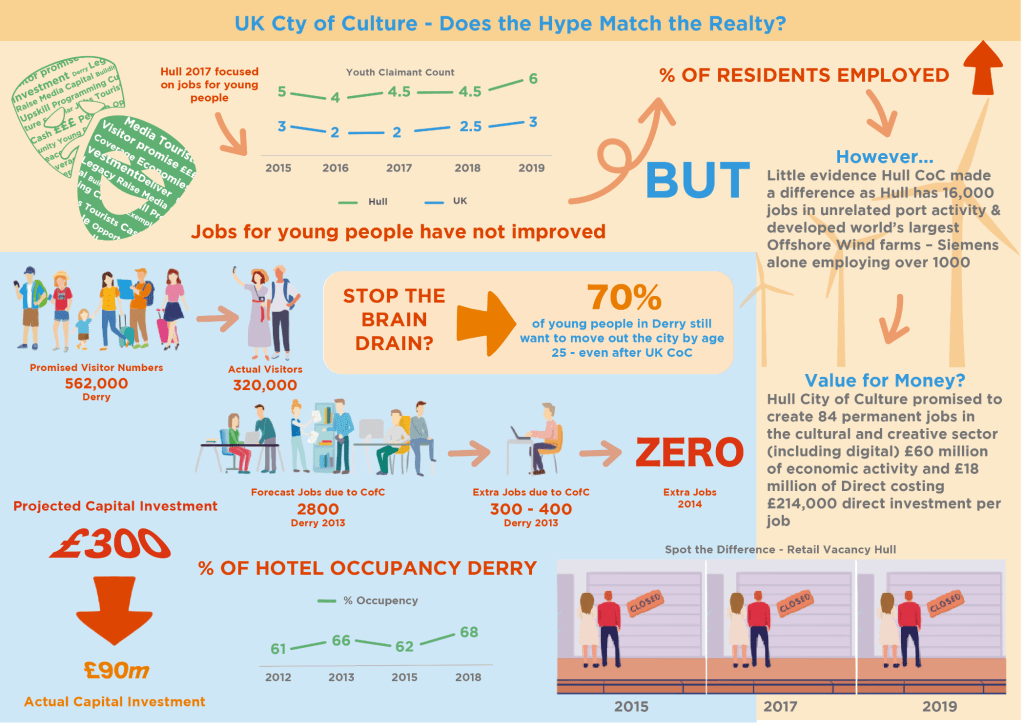
Following on from the perceived and touted successes of European Cities of Culture (EuCoC) such as Liverpool and Glasgow (2017, Boland, Mullan et al. 2018) the UK Government looked to replicate this through a UK organised simulacrum with the hope that the reported benefits of the supranational events would be replicated on a national event evidencing the trend of cultural “neoliberalisation” (McGuigan 2010)where culture is mobilised for alleged economic benefits (Boland, et al., 2018) (DCMS, 2017). The benefits posited included significant economic and social impact (Philip Boland, 2018) (Derry City and Strabane District Council, 2018) and demonstrate the development of a common narrative where culture is used as a tool of economic development (Van der Borg & Russo, 2005) (Cunningham, et al., 2018). This was crystallised in Department for Culture, Media and Sport’s (DCMS) mapping document: “The Creative Industries” (CITF, 1998) under the New Labour government of the time. Although the actual measurable benefits have been branded as “dubious” by some highly sceptical critics of neoliberal cultural regeneration such as Jim McGuigan (2010) and other commentators such as Beatriz Garcia (2004,2005) who also cast doubt on some of the claims made for the potential impacts claimed of City of Culture (CoC).  Some of the impacts promised for Uk City of Culture (UKCoC) were in fact, highly measurable, such as the forecast £100 million of media coverage and £300 million of capital investment (Derry City and Strabane District Council, 2018) and increases in visitors by 563,000 and increases in Hotel occupancy (Derry City and Strabane District Council, 2018) (ILEX, 2014) great promises were also made regarding halting the “brain drain” and in improving retention of young people, although no quantifiable targets were given in UKCoC documents (Derry City Council , 2010) (Derry City Council, 2013a) (Derry City Council, 2013b) (Boland, et al., 2018)

With the object of providing some insight into the direct economic impact of UKCoC, key datasets were identified, and relevant information extracted for analysis.  Sources included Northern Ireland Statistics and Research Agency (NISRA, 2017) UK Office for National Statistics (Office for National Statistics, 2020) Derry City and Strabane District Counci (Derry City Council, 2013a) (Derry City and Strabane District Council, 2018)l, ILEX (Derry development Company), Hull City Council (Hull City Council a, 2020) (Hull City Council b, 2020) and Humber LEP (Hull City Council b, 2020) and Centre for Cities (Centre for Cities, 2020).  It should be noted that where possible data has been sourced from organisations external to the UKCoC organisers, who may have a perceived bias to reporting only the positive facts (Hankinson, 2004) (Harvey, 2012).  This research is planned to contribute as part of a dissertation study of the impact, value and opportunity cost of UKCoC and its efficacy as a tool of urban regeneration and place-making.

There is an interesting contrast between the promises made for the UK’s City of Culture  (UKCoC) 2013Derry/Londonderry and those made for Hull’s bid for 2017 where some of the rhetoric – especially regarding measurable economic impact – was scaled down or readjusted to be measured in “soft” impacts rather than “hard“ impacts.  These “soft” impacts are more challenging to measure compared with the the easier to quantify “hard“ impacts such as employment levels  and can include such things as tourist expenditure, improvement in topophilia or reopening of formerly unused buildings for cultural activities and other, more intangible or indirect benefits  (Van der Borg & Russo, 2005). It might be overly cynical to assume a policy of deliberate obfuscation by UKCoC organisers and stakeholders – who were heavily invested in demonstrating UKCoC as a success – however a comparative analysis of the initial bid documents and subsequent post event impact reports by both Derry/Londonderry and Hull UKCoC organisers – ostensibly the local government authorities – show a disconnect between the promised “hard impacts” and the reporting of the actuality which often measures different indices and creates a difficulty for accurate quantifiable data analysis that would allow conclusions to be drawn as to whether the hyperbole was matched by reality – especially in terms of economic impact (Boland, et al., 2016) (Garcia, 2005). This is particularly noticeable in the Derry/Londonderry case where the post event evaluation report claims improvements but often don’t give baselines (Derry City Council , 2010) (Derry City and Strabane District Council, 2018).

One criticism of the seductive rhetoric of of UKCoC and European CoC is the appropriation of successes that are unrelated to the CoC bid (Connolly, 2013) (García, 2004).  The infographic attempts to represent this utilising the specific example of job levels, which were promised to increase through the efforts of Derry/Londonderry UKCoC (Derry City Council , 2010)and Hull UKCoC (Hull UK City of Culture 2017 Ltd, 2015). As shown in the infographic employment rate improved in the Hull NUTS3 area did have a faster rate of improvement c.f. national employment rates.  However the infographic demonstrates the importance of the port sector to employment in the city and that preceding and over the period of Hull UKCoC, Hull had become the base for supporting the world’s largest offshore windfarm with Siemens alone creating 1000 new jobs (Hull City Council a, 2020).This demonstrates the complexity of measuring the any proposed causal relationship for the longer term economic impact of UKCoC  (Liu, 2014) (Li & McCabe, 2012)

The long term legacy of the UKCoC programme was expected to include: culturally led regeneration, youth retention, youth employment, overall employment, inward investment both direct and indirect, increase in tourism, increase in media coverage and in the case of Hull a drop in retail vacancies (Derry City Council, 2013b) (Hull UK City of Culture 2017 Ltd, 2015)

Infographics can be used to explain an object, idea or process using clear illustrations in a way that unlocks the information being provided to give insights and clarity or present data in an interesting format that paints a narrative (Lankow, 2012) The attached infographic aims to present a critical analysis of some of the secondary data sources which represent the recorded impact of UKCoC and which challenge some of the existing narrative from organisers (Arts Council England, 2012) who almost consistently represent UKCoC as a driver for economic growth and job creation.  As such, rather than provide an holistic view of the impact of UKCoC, data sets chosen were those which emphasised the quantifiable impacts, especially, although not exclusively from an economic impact. The infographic exposes dichotomies between the hype and the reality of the impact of UkCoC and invites further analysis of the value proposition of UK CoC and whether it is ‘life and place changing’ or a ‘12 month party’? (Boland, et al., 2016), it further invites research into the opportunity cost of staging events such as UKCoC  as, if the wished for outcomes are – for example – a new cultural venue, more hotels, inward investment and more jobs, the question could be asked as to whether resource should be applied to achieving the outcomes directly rather than indirectly through a proposed and seemingly unproven “economic osmosis”. Indeed the major success in Hull in creating jobs seems unrelated to the CoC initiative but relate to port and wind farm activity (Hull City Council a, 2020) (Hull City Council b, 2020)  These questions become more pertinent as cities around the UK and the wider world face difficult decisions about the future shape of their place as the ongoing decline of traditional retail and the effects of Covid 19 impact the vitality of city centres and traditional uses. The homogenisation effects of assigning resource to, what appear to be, top down imported CoC “roadshows” could in fact act as a dampener on the creation of home grown local talent and the diminishing of indigenous, authentic and potential Foucauldian heterotopic assets within a city, that offer the promise of a more sustainable conduit to coherent communities, wealth and job creation. (Ntounis & Kanellopoulou, 2017)

References

Arts Council England, 2012. Measuring the Economic Benefits of Arts and Culture – practical Guidance on Research methodologies for Arts and Cultural Organisations. London: Arts Council England.

Bianchini, F. & Parkinson, M., 1993. Cultural policy and urban regeneration: the West European experience. Manchester: Manchester University Press.

Boland, P. B., Murtagh & Shirlow, P., 2016. Fashioning a City of Culture: ‘Life and Place Changing’ or ‘12 Month Party’?. International Journal of Cultural Policy.

Boland, P., Mullan, L. & Murtagh, B., 2018. Young people in a city of culture: ‘Ultimate beneficiaries’ or ‘Economic migrants’?. Journal of Youth Studies, 21(2), pp. 178-202.

Centre for Cities, 2020. Centre For Cities. [Online]
Available at: https://www.centreforcities.org/data-tool/su/506a2355
[Accessed 1 March 2020].

Connolly, M. G., 2013. The ‘Liverpool model(s)’: cultural planning, Liverpool and Capital of Culture 2008. International Journal of Cultural Policy , 19(2), pp. 162-181.

Cunningham, Isaac & Platt, L. C., 2018. Bidding for UK City of Culture: Challenges of delivering a bottom-up approach ’in place’ for a top-down strategy led scheme. Journal of Place Management and Development, Volume 11.

DCMS, 2017. UK City of Culture 2021: Bidding Guidance, London: Department for Culture, Media and Sport.

Derry City and Strabane District Council, 2018. Post Project Evaluation of City of Culture 2013, Derry City: Derry City and Strabane District Council.

Derry City Council , 2010. Cracking the Code. City of Culture 2013, Derry: Derry City Council .

Derry City Council, 2013a. Our Legacy Promise. Building on the Success of 2013, Derry: Derry City Council.

Derry City Council, 2013b. Legacy Plan 2013–2023, Derry: Derry City Council.

García, B., 2004. Cultural Policy and Urban Regeneration in Western European Cities: Lessons from Experience, Prospects for the Future. Local Economy, Volume 19(4), pp. 312-316.

Garcia, B., 2005. Deconstructing the City of Culture: The Long-term Cultural Legacies of Glasgow 1990. Urban Studie, 42 (5/6)(May), pp. 841-868.

Garcia, B., 2017. ‘‘If everyone says so …’ Press narratives and image change in major event host cities’. Urban Studies, Volume 54(14), p. 3178–3198.

Hankinson, G., 2004. Relational network brands: Towards a conceptual model of place brands. Journal of Vacation Marketing, 10(2), p. 109–121.

Harvey, D., 2012. Rebel Cities: From the Right to the City to the Urban Revolution. London: Verso.

Hull City Council a, 2020. Greenport Hull. [Online]
Available at: https://greenporthull.co.uk/jobs-training/job-roles-in-offshore-wind-1
[Accessed 20 March 2020].

Hull City Council b, 2020. InvestHull. [Online]
Available at: https://investhull.co.uk/sectors/port-logistics
[Accessed 12 March 2020].

Hull UK City of Culture 2017 Ltd, 2015. Hull UK City of Culture 2017 Strategic Business Plan 2015-2018, Hull: Hull UK City of Culture 2017 Ltd.

ILEX, 2014. Final Monitoring Report, Derry City of Culture, Derry/Londonderry: ILEX- .

Lankow, J., 2012. Infographics: the power of visual storytelling. s.l.:Wiley-Blackwell.

Li, S. & McCabe, S., 2012. Measuring the Socio‐Economic Legacies of Mega‐events: Concepts, Propositions and Indicators. International Journal of Tourism Research, pp. 388-402.

Liu, Y.-D., 2014. Socio-Cultural Impacts of Major Event: Evidence From the 2008 European Capital of Culture, Liverpool. Social Indicators Research, 115(3), pp. 983-998.

McGuigan, J., 2010. Neoliberalism, urban regeneration and cultural policy. In: Cultural analysis. London: SAGE Publications Ltd, pp. 117-128.

NISRA, 2017. People and Places, Local Government District Tourism Statistics (Northern Ireland), Belfast: Northern Ireland Statistics and Research Agency (Tourism Statistics Branch).

Ntounis, N. & Kanellopoulou, E., 2017. Normalising jurisdictional heterotopias through place branding: The cases of Christiania and Metelkova. Environment and Planning A: Economy and Space, 49(10), pp. 2223-2240.

Office for National Statistics, 2020. Office for National Statistics. [Online]
Available at: https://www.ons.gov.uk/

Philip Boland, L. M. B. M., 2018. Young people in a city of culture: ‘Ultimate beneficiaries’ or ‘Economic migrants’?. Journal of Youth Studies, Volume 21:2, pp. 178-202.

Van der Borg, J. & Russo, A., 2005. The Impacts of Culture on, Rotterdam: European Institute for Comparative Urban Research (EURICUR) Erasmus University.

Background on Tourism Statistics produced for Gloucestershire

Below are some technical data on Sources and data for the Gloucestershire Tourism statistics including definitions
What is GBTS?

The Great Britain Tourism Survey is undertaken by TNS for VisitBritain and is based
on approximately 2,000 face-to-face per week throughout the year as part of TNS’s
RSGB Omnibus survey. It provides basic headline data on the volume and value of
domestic tourism, for England as a whole, for the English regions and for the
counties or unitary authorities.
What is IPS?
The International Passenger Survey is conducted by Office for National Statistics
and is based on face-to-face interviews with a sample of passengers travelling via
the principal airports, sea routes and the Channel Tunnel, together with visitors
crossing the land border into Northern Ireland. Around 0.2% of all travellers are
interviewed, with approximately 55,000 interviews of overseas visitors obtained
throughout the year. IPS provides headline figures, based on the county or unitary
authority, for the volume and value of overseas trips to the UK.
What is GBDVS?
In 2011, VisitEngland, Visit Scotland and Visit Wales commissioned a new survey to measure volume and value of tourism day visits in England. A number of earlier
surveys were conducted to measure this key sector of the economy, most recently in
2005, but it has been difficult to make comparisons over time due to changing
definitions and survey methodologies. In the new survey, interviewing is carried out
weekly, using an online methodology, and an annual sample of over 38,000
interviews with GB adults. The GB Day Visits Survey is an Official Statistic, and is produced in adherence with the Code of Practice for Official Statistics (2009).

What is the England Occupancy Survey?
As part of the EU Directive on Tourism Statistics adopted in 1995, the UK must
report regularly a specified range of statistics to Eurostat, the official statistical office
of the European Community. Included in these statistics are monthly occupancy
rates for UK serviced accommodation. The responsibility for providing this data lies
with the four National Tourist Boards. A sample of establishments are recruited to
the survey and asked to complete a data form each month, giving details of their
nightly room and bed occupancy. The data returned is processed and analysed to
produce monthly occupancy rates for the whole area and for specific types of
accommodation providers, size of establishment, location etc.
What is the ASHE?
The Annual Survey of Hours and Earnings (ASHE) provides information about the
levels, distribution and make-up of earnings and hours worked for employees in all
industries and occupations. The ASHE is a new survey developed to replace the
New Earnings Survey (NES) from 2004, including improvements to the coverage of
employees, imputation for item non-response and the weighting of earnings
estimates. The ASHE is based on a 1 per cent sample of employees in United Kingdom
What is the Labour Force Survey?
The LFS is a household panel survey of employment, continuous since 1992, with
results produced each quarter. It has a sample of approximately 60,000 households.
The LFS is the government’s largest continuous household survey and participation
in the survey is voluntary. LFS data are weighted to enable population estimates to
be produced. The weighting also attempts to compensate for differential non-response among different subgroups in the population. LFS is designed to provide information on the UK labour market that can be used to develop, manage and evaluate labour market policies. Aspects reported include rates of employment, unemployment and economic activity.
Terms used
What is a day visitor?
A day visitor is defined as someone making a day trip to and from home
for leisure purposes. The report excludes trips undertaken for business or study purposes. This report presents data on those who took trips of at least 3 hours duration on an irregular basis as defined by the GBDVS 2011. These are identified as tourism day
trips by the Departmentof Culture, Media and the Sport.
What is a staying visitor?
A visitor staying away from home for at least one night. Often measured in trips to
overcome the issue of one visitor making two or more trips to an area in a given
period.
What are VFR trips?
VFR trips are those where visiting friends or relatives is the main purpose for making
a trip. While many trips to visit friends and relatives will be accommodated in the
homes of these friends/relatives, some will make use of other forms of accommodation. It should also be noted that other forms of trip, for instance for holiday or business purposes, may stay with friends and relatives rather than in commercial ccommodation.
What is a multiplier?
Additional activity arising as a result of an initial direct input. Two forms of multiplier
are used in the model, namely indirect or supply multipliers, representing the additional economic activity arising from the purchase of supplies and services by businesses in direct receipt of tourism spending; and induced multipliers arising from additional economic activity supported by the expenditure of wages earned by employees in businesses supported directly or indirectly by tourism spending.
What are full time equivalent jobs (FTE’s)?
A FTE is defined as a job involving an input of 37 or more hours work per week for a
full year. For the purposes of the Model, the total number of FTE jobs is the number
of full time jobs that the number of actual jobs equates to. For example, 2 part time
all year round jobs, each covering 18.5 hours per week would equate to 1 FTE job.
What are actual jobs?
This figure gives the actual number of jobs, regardless of the amount of hours
worked or the seasonality of the employment. For example, 3 part time jobs and 2
full time jobs would equal 5 actual jobs. Many jobs are seasonal or part-time in
nature in the tourism sector, so an adjustment is made to calculate the actual
number of jobs from the number of FTEs. The adjustment is based on the findings of
surveys of tourism related businesses, and national employment surveys.
What are direct jobs
For the purposes of this model jobs have been categorised as direct, indirect or
induced. Direct jobs are those in businesses in receipt of visitor spending. For
example, jobs supported by visitor spending at a hotel would be direct jobs.
What are indirect jobs?
Indirect employment arises as a result of expenditure by businesses in direct receipt
of visitor expenditure on the purchase of goods and services for their businesses.
For example, some of the employment at a business supplying food and drink may
be supported through the supplies that the business sells to hotels (or any other
business in direct receipt of visitor expenditure).
What are induced jobs?
Induced jobs are those that are supported by the spending of wages by employees
in direct and indirect jobs. Such spending will be spread across a wide range of
service sectors.
What are total jobs?
Total jobs include those in tourism related businesses supported by tourist spending
and those indirectly arising or induced by spending across the service sector in
suppliers of goods and services.
Direct jobs + indirect jobs+ induced jobs = Total jobs
What is ‘other tourism spend’?
Apart from expenditure associated with the individual trips, some
forms of activity also involve ongoing expenditure on accommodation, for instance second home or boat maintenance, or result in additional spending by non-
visitors, for example friends and relatives with whom the tourist is staying. These other areas of expenditure are categorized as ‘other tourism spend’.

The Mathematical model

How does the model work?

The Cambridge Model is a computer-based model developed to calculate estimates
of the volume, value and economic impact of tourism on a County or District basis.
It draws on the combined experience of PA Cambridge Economic Consultants Ltd,
Geoff Broom Associates and the Regional Tourist Boards and utilises a standard
methodology capable of application throughout the UK. It therefore offers the potential for direct comparisons with similar destinations throughout the country. The approach was the subject of independent validation (R.Vaughan, Bournemouth University) in December 1994. The Model was judged robust and the margins of error acceptable and in line with other modelling techniques.
What are the model’s limitations?
The Model in its basic form relies on using information from a range of sources,
outlined above. The methodology and accuracy of these sources varies, and
therefore the estimates can only be regarded as indicative of the scale and importance of visitor activity in the local area. Thus the Model cannot take account
of any leakage of expenditure in and out of the local area from tourists taking day
trips in or out of the area in which they are staying. While it is assumed that these
may broadly balance each other in many areas, there will be an underestimate in
relation to overseas day visits from holiday accommodation in London to locations
receiving significant numbers from that source. Similarly, there is no information in
the 2012 Great Britain Day Visits survey with regard to business day trips. As with all
models, the outputs need to be viewed in the context of local information and
knowledge. Because of the data sources and modelling process, there will be a
potentially large margin of error associated with individual figures,
with small numbers being particularly prone to such errors. Therefore the outputs should be taken as indicative rather than definitive.

A record 7% of jobs in Gloucester are reliant on the growing tourism sector

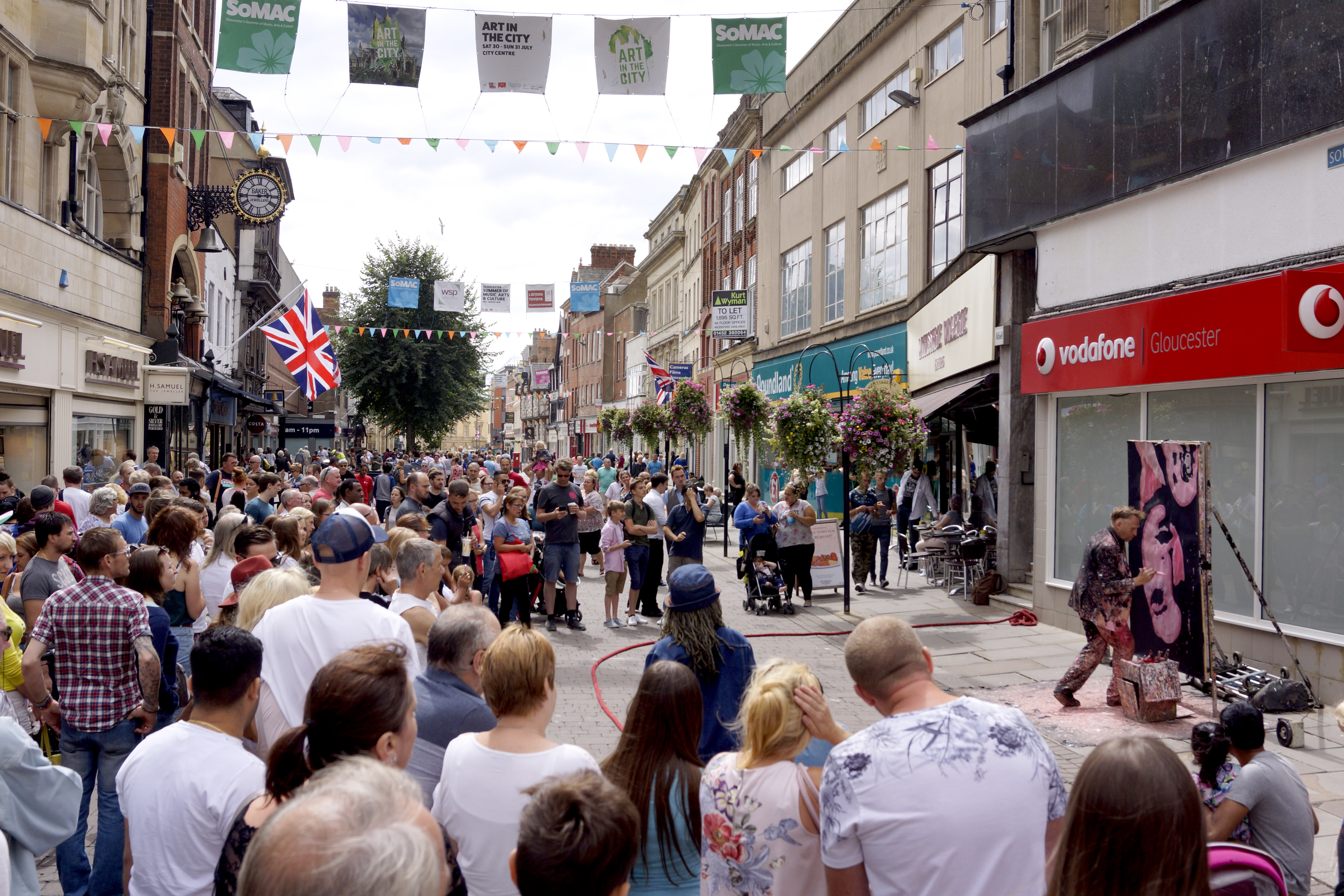
It can hardly have passed anyone by who visits Gloucester today, that there have been massive changes in the last ten years.  Nowhere have these changes been reflected more than in the massive growth in the number of day visitors and tourists visiting the city from elsewhere in the UK and abroad. The growing success of Gloucester Quays and its events, the beautiful regeneration to the Cathedral quarter, the beautiful historic docks, the refurbished Waterways Museum and this year the restored Llanthony Secunda Priory along with successful events such as the Tall Ships Festival, Aethelflaed elebrations, SoMAC, Gloucester History Festival and the Three Choirs Festival have all contributed to providing activities and attractions for visitors that has led to a phenomenal growth in visitors to the city.

SoMAC-Art-in-the-City-banners

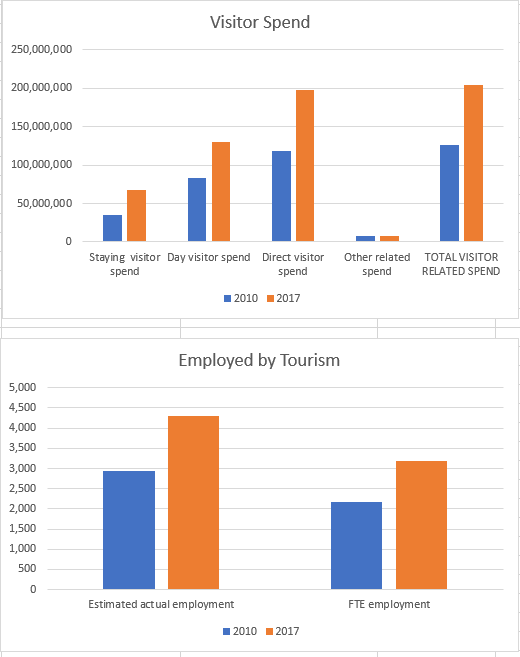
In 2015 Gloucester overtook Cheltenham in terms of the number of day visitors and total spend of visitors in the city. with nearly £205 million spent by visitors in 2017, an 62% increase on 2010.

Some highlights from the independent research which has been commissioned by Marketing Gloucester.

In 2017 there were :

3,203,000 day visits by tourist to Gloucester

920,000 nights stayed in Gloucester Hotels, B&Bs and so-on

An increase in the proportion of employment related to tourism from 5% of jobs to 7%


Capture

Jason Smith Chief Executive of Marketing Gloucester commented “Gloucester is now very firmly on the tourist map and these figures demonstrate how important it is that as a city we plan for the expected continued growth.  It is crucial that we particularly facilitate the development of new hotels, especially in the fully serviced sector as due to the few hotels we have, the strong growth in overnight visitors will be restricted.  It is also important going forward that we ensure that we have skilled staff in the hospitality sector and continue to invest in developing bookable products for tour operators”

Paul James, leader of Gloucester city Council, is Chairman of Marketing Gloucester and he said that he was encouraged by the figures commenting “All of the efforts that are going into regeneration of the city by the council, cathedral and private sector partners such as Peel, alongside the high profile promotion for the city which has been led on by Marketing Gloucester are really bearing fruits, bringing money and jobs to the city. Undoubtedly as Kings Quarter and other projects around the city are completed, we are likely to see the number of tourist and spend continue to increase”

Recently Marketing Gloucester was successful in bidding for part of a £500,000 fund to bring in US tourists to the city

Preparing for Full Fibre, Scoping Study commissioned for Gloucestershire Joint Core Strategy Area

imagesThe Fastershire project is seeking the services of a suitably qualified consultant to help crystallise an understanding of the need, demand, opportunity, and potential for pervasive full fibre connectivity within the urban localities of Gloucestershire. The study will need to identify the needs of and available infrastructure assets owned by public sector partners including local councils, the NHS and emergency services as well as the education sector. Additionally it will need to investigate and assess the appetite of various private sector organisations to leverage the demand and assets of the public sector to generate full fibre connectivity more widely. In the first instance to key business parks, regeneration zones, GPs Surgeries and student accommodation but potentially further providing all pervasive residential and business access to full fibre access across the Study Area.
https://procontract.due-north.com/Advert?advertId=ac3e26bb-cd64-e811-80eb-005056b64545&p=696a9836-1895-e511-8105-000c29c9ba21

Invitation to tender for Big Screen in Gloucester

20171124_164528

Gloucester BID Team

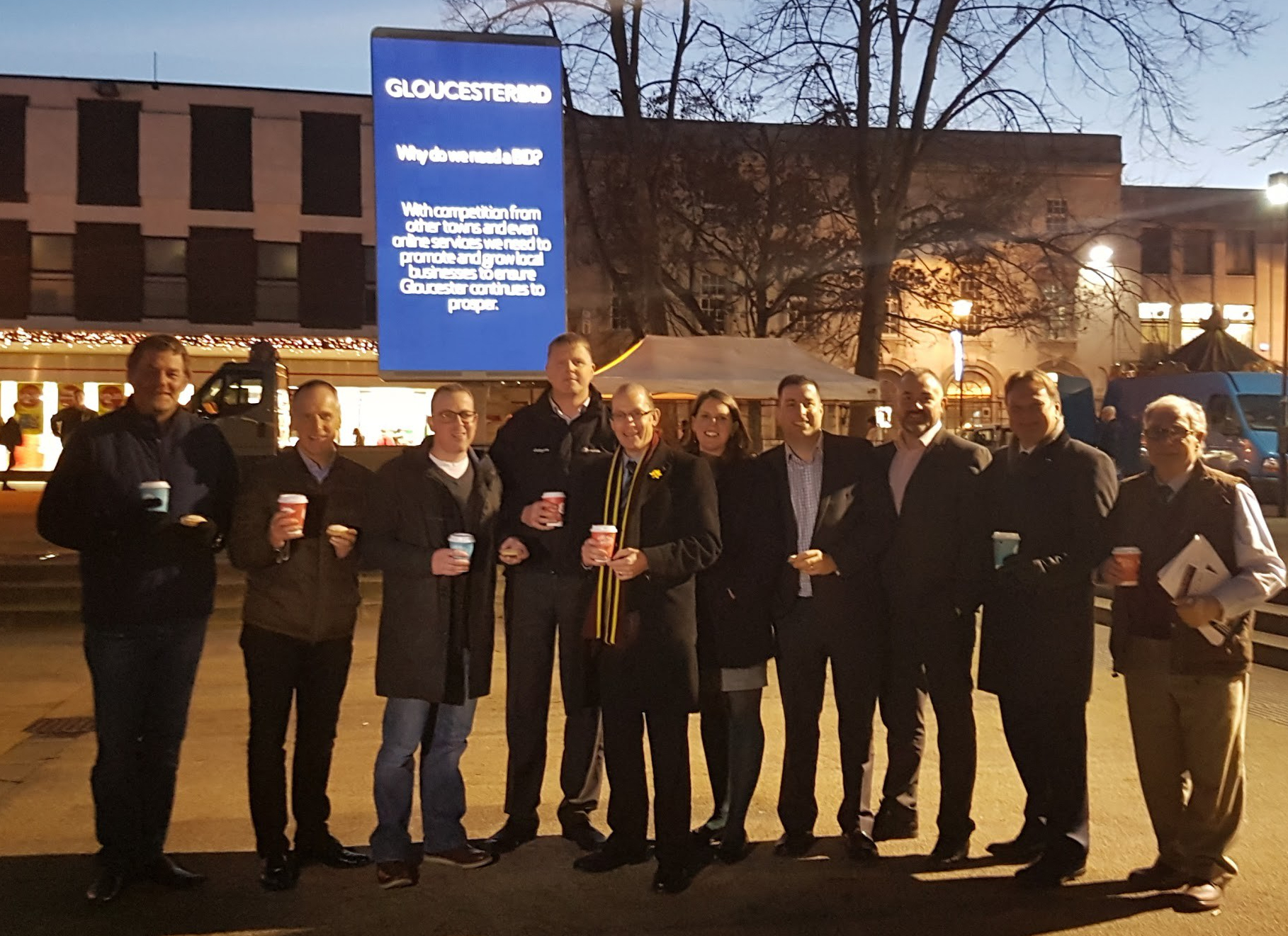
Gloucester Business Improvement District (Gloucester BID) are inviting expressions of interest for a rotating 15sqm digital screen to be installed in Kings Square Gloucester.

The screen shall rotate from vertical to horizontal and pivot on its base.

Please provide an estimate for manufacture, full installation, including groundwork and power connection and maintenance for the screen and supply of appropriate software to drive content

Any responses will be evaluated against the following criteria:

  • Expertise to design, develop and offer ongoing support to any solution provided.
  • Established trading record
  • Number of large format LED installations in the last 12 months
  • Ability to demonstarte UK based service and maintenance team
  • Demonstrate ability to service and maintain LED tiles

All expressions of interest or further queries must be addressed through email to hannah@gloucesterbid.org.uk

Closing date for expressions of interest 16th February

2018 Centre for Cities report describes Gloucester’s strengths and opportunities for growth

Below is a link to the Centre for Cities 2018 report which includes information on Gloucester.

Caveat

The report uses very sound metrics but it is nevertheless important to note that the geographic area relates to just the area covered by the local authority (LAU1) – in this case Gloucester city council.  This means that  the report’s conclusion on jobs, skills and so-on would not for example include data on businesses at Twigworth, Gloucester Business park, Staverton and so-on which for the purpose of this report are excluded.

http://www.centreforcities.org/wp-content/uploads/2018/01/18-01-12-Final-Full-Cities-Outlook-2018.pdf

Highlights include Gloucester:

  • Schools performing in top quartile nationally
  • Ranked 4th of 63 cities for having highest employment rates (structurally full employment)
  • 2% of city exports to China and growing
  • High level of services exports
  • Good levels of growth in high value jobs c.f. many cities (but still middle ranked)


  • DVB6oD9XkAEXzuJ.jpg


With the proposed Super City suggested in the #Glos2050 Big Conversation, we have asked Andrew Carter CEO of Centre for Cities would run an exercise using current benchmarks to see how these figures would be affected if the model was working today.  Marketing Gloucester will be assisting in providing data.  Currently Centre for Cities do not include Cheltenham as it falls below the threshold (135,000 users per day).

For further information contact info@marketinggloucester.co.uk