Government publishes European funds guidance for #LEPs

Government publishes European funds guidance

BIS has published a guidance for Local Enterprise Partnerships on how they should set priorities for the next round of EU funds.

In April 2013 the Government issued preliminary guidance to LEPs on how to develop their EU Structural and Investment Fund Strategies. Thissupplementary guidance sets out the information that should be included in the strategies and the criteria that will be used by Government to evaluate them.

The Local Enterprise Partnerships are asked to send their first draft of European Strategic and Investment plans by Monday 07 October 2013. The plans will be finalised by July 2014.

Download the guidance here (pdf 1,164KB)

Read more in our press release below (19 July 2013).

NCVO – European funds guidance is good news for charity sector


NCVO has welcomed today’s release of the Government’s supplementary guidance for Local Enterprise Partnerships, the 39 local bodies which will determine how key European funds are spent in England in the next European funding round, which runs from 2014-2020 (1).

The guidance sets out how LEPs should set priorities for their allocation of the EU Structural and Investment Funds, and reflects a number of calls from NCVO and its European Funding Network.

Key wins for the sector include:

–              Confirmation that at least 20% of the European Social Fund (ESF) must be directed to ‘social inclusion’ work, much of which could be delivered by the voluntary sector. This is a significant increase from the level of ESF funding which has reached such projects under the current funding round (2). This means around £1bn will become available for social inclusion work from 2014-2020 – £500m from the fund, matched by an additional £500m of other funding. Investments in social inclusion work are likely to be in areas such as education, training and employability.

–              The news that Big Lottery Fund has proposed to offer the necessary match funding for local social inclusion projects (3).

–              News that volunteers’ time can now be considered as an investment for the purposes of matching European funds.

–              The opportunity for social investment to be considered for matching European funds.

–              A requirement that LEPs involve the local voluntary sector in setting their priorities for how European funds are spent in their areas

–              Aside from the ESF, the other major fund, the European Regional Development Fund, may also provide opportunities for the sector. This money is intended for investment in sustainable capital development, and could be used for example to develop low-carbon retro-fitting of community buildings and social innovation start-ups.

Sir Stuart Etherington, chief executive of NCVO, said:

‘These are major and meaningful wins for the voluntary sector, which holds much of the expertise in promoting social inclusion. The result of today’s announcements will be more European money reaching charities and the people we work with.

‘I am pleased to see that both the government and the Big Lottery Fund have responded to our calls to explore how to make match funding easier for charities and social enterprises. I hope this will be a significant step forward in helping these funds reach the voluntary sector.

‘Charities make an important contribution to the economy and economic recovery, for example in supporting people to develop their skills. LEPs now have a significant opportunity to unleash this power of the voluntary sector in promoting economic recovery and I look forward to working with them and our local partners to help them make the most of this.’

Notes

1)       The guidance will be published online shortly on the BIS website https://www.gov.uk/government/policies/making-european-funding-work-better-for-the-uk-economy/activity

2)       Based on research by TSEN, now part of NCVO, into the use of ESF in the current round of funds (2007-2013)http://europeanfundingnetwork.eu/policy/cohesion-policy-2014-2020/CivilSocietyInvolvementESFProgramme200720131.pdf

3)      European Structural and Investment Fund money must be matched by a domestic funder – this can be local or national government; private sector or voluntary sector – in order to become available.

For more information, please contact Oli Henman, Head of EU & International, Direct line: 020 7520 2550
What is a Balance Sheet Recession

 
A balance sheet recession occurs when the private sector is focused on paying down debt and unwilling to borrow and spend (despite zero interest rates). This reluctance to spend and invest causes a sustained weakness in aggregate demand and lower growth.
 
In a balance sheet recession the banking sector is unwilling to lend because it needs to improve its balance sheet and increase bank reserves.
 
A balance sheet recession also usually involves falling asset prices and deflationary pressures.
 
For example, in 1991, the UK experienced a recession caused by a demand side shock (high interest rates and strong pound). When interest rates were cut and the pound devalued, the economy was able to recover. However, in a balance sheet recession, the problem is more fundamental than a temporary demand side shock. This explains why when interest rates were cut in 2008, it failed to solve the recession – because firms, banks and consumers were trying to reduce exposure to debt and increase saving.

Other Features of Balance Sheet Recessions

  • Liquidity trap – zero interest rates fail to boost spending or investment because firms and consumers can’t afford to borrow more despite the lower interest rates. (liquidity trap)
  • Falling Asset prices – The reluctance to borrow means demand for mortgages and houses will fall. This leads to a sustained fall in asset prices. Falling asset prices tend to exacerbate bank losses, making banks even more reluctant to lend.
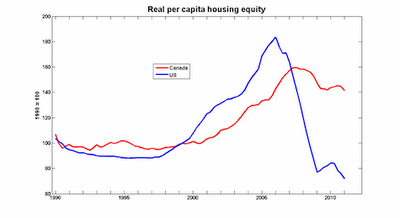
Graph showing the extent of how much house prices in the US have fallen since start of balance sheet recession. Source: Economists view
  • Deflationary Pressure. The combination of falling asset prices and stagnant economy can lead to disinflation or actual deflation. Deflation increases the real value of debt and increases the pressure on firms to pay down debt rather than invest or spend.
  • Higher saving rates.
saving
 
Before the recession, saving rates fell to very low levels as borrowing increased. Following the start of the recession, saving rates increased in countries like Ireland, UK and US as consumers tried to pay off debts and increase savings.
  • Low Bond Yields. Typically, higher government borrowing leads to higher interest rates (markets fear default). However, in a balance sheet recession, there is high demand for government bonds (because the private sector are risk averse and want to increase savings. Government bonds are seen as one of most relatively secure.
E.g. Japan had government sector debt of over 220% of GDP, yet bond yields were as low as 1%.
In 2011, The US has seen a fall in bond yields to 1.75% on 10 year treasury bonds, despite a rise in government borrowing.
 
Problems of Balance Sheet Recession
  • Conventional monetary policy is insufficient to boost demand. Lower interest rates not enough to encourage spending and investment.
  • Fall in private sector spending, creates shortage of demand.
  • Negative multiplier effect. Unfortunately, falling asset prices leads to big debts for banks and a greater reluctance to spend.
  • Deflation. A deflationary spiral discourages further spending and increases real value of debt.
  • They can last a long time. e.g. Lost decade of Japan. Prospect of double dip recession in west and a long period of stagnant incomes, high unemployment and low growth.
  • Scope for biflation (both commodity price inflation and deflation of other goods at same time)

Social enterprises out-performing traditional SMEs – How can LEPs best leverage the growth potential?

Business Secretary Vince Cable will speak at the launch of The People’s Business report today in Westminster. 

Tuesday 9 July 2013 READ REPORT

New figures published today in The People’s Business report reveal a thriving social enterprise sector in the UK that is attracting a wave of entrepreneurs. UK-wide research [1] carried out for The People’s Business shows that social enterprise has three-times the start-up rate of the mainstream SME sector [2]. Close to a third of all social enterprises are three years old or younger.

The report, released by Social Enterprise UK and supported by The Royal Bank of Scotland Group, says that social enterprises are much more likely to be led by women than mainstream businesses. Thirty eight per cent of social enterprises have a female chief executive, compared with 19% of SMEs, and 3% of FTSE 100 companies [3].

The figures show that people are gravitating from mainstream business to carve out a career in social enterprise. More people are moving from the private sector than any other sector to work in social enterprise (35%, compared with 33% from the public sector and 17% from charities and the voluntary sector).

The report also reveals a promisingly diverse sector. Almost a quarter (23%) of social enterprises are run by younger leaders aged 25-44, while one in ten (13%) are led by ‘silverpreneurs’ – people over the age of 65. And social enterprises are twice as likely as mainstream SMEs to be led by someone with a Black, Asian or Minority Ethnic background.

There are currently 70,000 social enterprises in the UK contributing £18.5 billion to the UK economy and employing almost a million people [4]. These businesses with a social mission include The Big Issue, Pants to Poverty, Belu Water and Jamie Oliver’s Fifteen.

Social enterprises out-performing traditional SMEs

Findings in The People’s Business point to social enterprises out-performing mainstream businesses. In the last 12 months, 38% of social enterprises surveyed saw an increase in their turnover compared with 29% of SMEs. More than half of social enterprises (56%) developed a new product or service, compared with 43% of SMEs. Two-thirds (63%) of social enterprises expect their turnover to increase in the next two to three years, almost double the number of SMEs (37%).

Creating jobs and tackling deprivation in local communities

The research shows that social enterprises are creating jobs and stimulating local economies where they’re needed most. More than a third (38%) of all social enterprises operate in the UK’s most deprived communities, compared to 12% of traditional SMEs – and half of social enterprises (52%) actively employ people who are disadvantaged in the labour market, including ex-offenders, people with disabilities and the long-term unemployed.

The majority of social enterprises (57%) draw 100% of their workforce from the local areas in which they operate, and a greater number of social enterprises are planning to grow their staff teams over the next 12 months than two years ago (33% expect to employ more people, compared to 26% in 2011).

Access to finance is main barrier to growth

Social enterprises say that access to finance is their single biggest barrier to growth and sustainability. Hungry for finance, twice as many social enterprises as SMEs sought capital in the past 12 months (48% compared with 24%). The average sum applied for by social enterprises was £58,000, suggesting a need for smaller-scale lending than is currently available to the sector from social investment sources.

In 2011, just 8% of social enterprises cited the economic climate as a barrier to growth – in 2013 this figure has quadrupled to 32%, the second biggest barrier for social enterprises to grow and become sustainable.

For social enterprises who mainly trade with the public sector, there has been an increase in the number who report prohibitive public sector commissioning and procurement as a major barrier to growth and sustainability. In 2013 the figure stands at 34%, up from 25% in 2011. That this situation has worsened rather than improved since the last survey should be of concern for policy-makers, says Social Enterprise UK.

The report makes a number of recommendations, including that:

  • Government should implement the Public Services (Social Value) Act to its full effect to public service markets with genuine plural provision in which smaller social enterprises can compete.
  • Policymakers and investors should recognise that grants and ‘softer’ social investment (which is patient and risky) remain critical parts of the mix for many social enterprises, and design financial products and support programmes to reflect this.

APPG Local Growth and LEPsinvites you to give evidence on LEPs by 19th July

‘Rising to the Challenge’ inquiry

In the wake of the Spending Review and the Government’s announcements on the size of the Single Local Growth Fund, the APPG on Local Growth and LEPs is inviting evidence from all interested parties on three themes: the evolution of LEPs, LEPs and value for money and LEPs’ capacity for local political leadership, particularly in bringing local authorities together across boundaries. The call for evidence is attached and written evidence is requested by 19th July 2013 (contact us if this presents difficulties).


Previous reports have secured national media coverage and been well received by Ministers. Verbal evidence sessions in Parliament chaired by APPG officers including Caroline Dinenage MP, James Morris MP and Andy Sawford MP are currently being scheduled – if this opportunity is of interest please get in touch via appgchallenge@westminster.gov.uk ASAP.

LEP allocations for ERDF and ESF 2014 to 2020 published 27.6.2013

Annex:

LEP Allocation €m
Black Country 177.4
Buckinghamshire Thames Valley 13.9
Cheshire and Warrington 142.2
Coast to Capital 67.3
Cornwall and the Isles of Scilly 592.9
Coventry and Warwickshire 136.0
Cumbria 91.4
Derby, Derbyshire, Nottingham and Nottinghamshire 249.7
Dorset 47.3
Enterprise M3 45.7
Gloucestershire 38.3
Greater Birmingham and Solihull 255.8
Greater Cambridge & Greater Peterborough 75.5
Greater Lincolnshire 133.5
Greater Manchester 415.6
Heart of the South West 118.3
Hertfordshire 69.5
Humber 102.4
Lancashire 266.3
Leeds City Region 391.2
Leicester and Leicestershire 126.3
Liverpool City Region 221.9
London 748.6
New Anglia 94.5
North Eastern 539.6
Northamptonshire 55.0
Oxfordshire LEP 19.4
Sheffield City Region 203.4
Solent 43.1
South East 185.9
South East Midlands 88.3
Stoke-on-Trent and Staffordshire 161.6
Swindon and Wiltshire 43.6
Tees Valley 202.6
Thames Valley Berkshire 28.7
The Marches 113.7
West of England 68.6
Worcestershire 68.1
York and North Yorkshire 97.5

Worcs LEP welcomes £4.9m investment in Hoobrook Link Road Project @wlep @thelepnetwork

Worcestershire LEP welcomes the announcement from the Department for Transport that £4.9 m has been awarded from its ‘Pinch Point’ fund to support the second phase of the Hoobrook Link Road development in Kidderminster.

The money will be used towards  the completion of the Link Road between the Stourport Road and the Worcester Road around Kidderminster.  This will open up the South Kidderminster Enterprise Park  as well as alleviating a local ‘pinch point’ comprising several roads with serious traffic congestion, particularly at peak times, and it will release further large areas of land for housing and employment development.

Peter Pawsey, Executive Chair at Worcestershire LEP, said: “One of the key objectives of Worcestershire LEP is to support the delivery of key transport infrastructure projects.  The Hoobrook Link Road will significantly relieve congestion on the road systems, improve access to the site and thereby facilitate the regeneration of this area.  It will help breath new life into Kidderminster.“

http://www.wlep.co.uk/lep-welcomes-investment-in-hoobrook-link-road-project/

“Where next for LEPs?” – new report by Smith Institute & RSA 11 June 2013.

Against the backdrop of low growth and prolonged austerity
the LEPs face a formidable challenge, especially in places where
structural unemployment is already a problem. However, as
the perspectives in this monograph demonstrate the 39 LEPs,
although arguably still in their infancy, are working hard to find
local solutions which draw in extra investment and utilise local
skills and expertise…….

Please follow Link to full document

Click to access Where%20next%20for%20Local%20Enterprise%20Partnerships%20%282%29.pdf


Full APPG report recommending LEPs greater role in shaping skills provision now available for download

Image


Make skills and back to work schemes work for local economies, urge MPs LINK TO FULL REPORT BELOW

Download a copy of the report here

A cross-party group of MPs and peers has urged the Government to give Local Enterprise Partnerships (LEPs) a greater role in shaping skills provision and back to work schemes in order to boost local growth.  Download the full report above